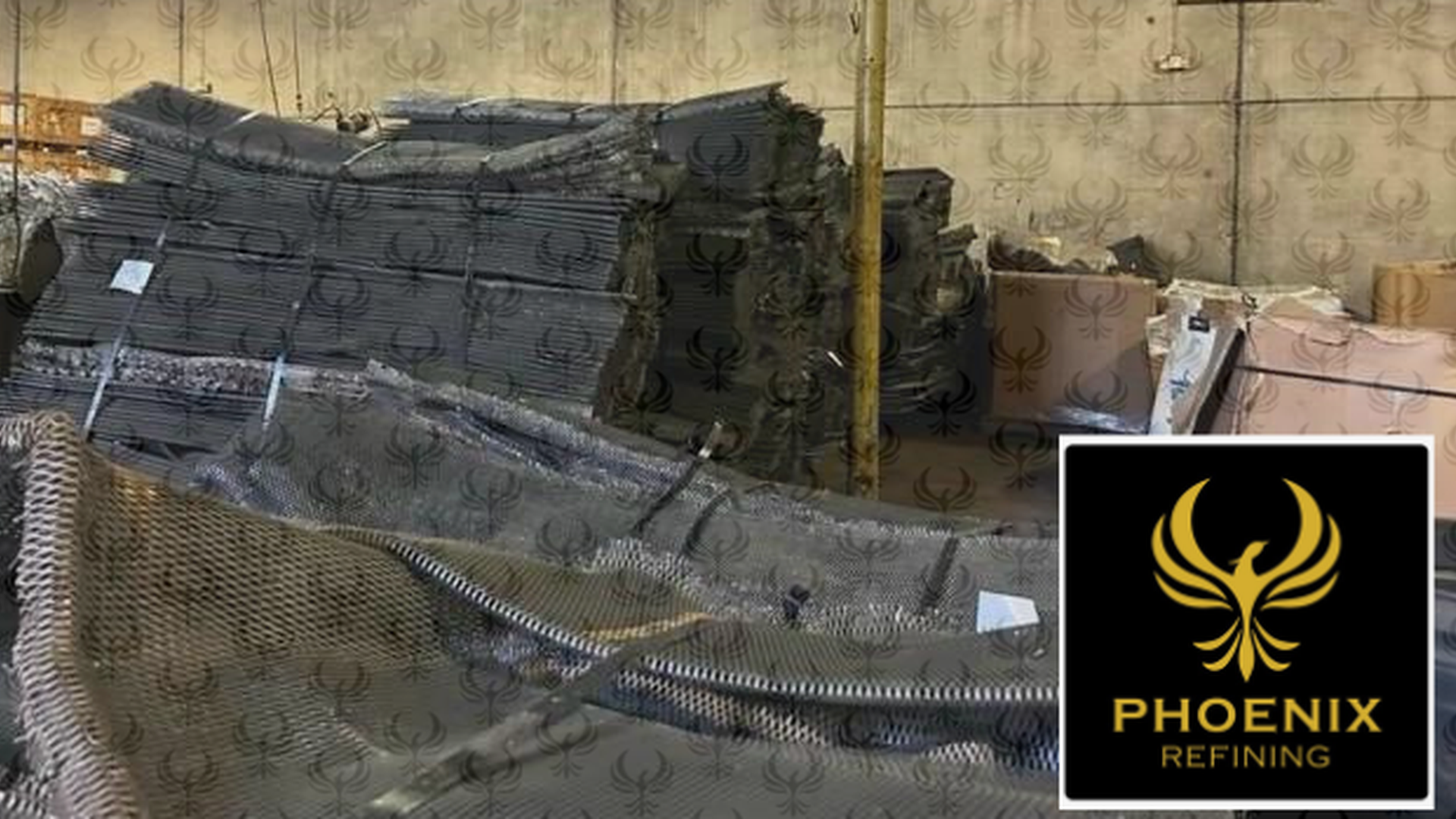
A dark titanium screen arriving from a water-treatment plant may look like ordinary industrial scrap. Sorting it into the general titanium bin, however, could send recoverable precious metals into a recycling stream that is not designed to capture them.
The material may be a mixed metal oxide (MMO) electrode, also known as a dimensionally stable anode (DSA). These components typically combine a commercially pure titanium support with a thin catalytic coating containing ruthenium, iridium, or other metal oxides. For recycling yard managers, sorting technicians, and maintenance staff, the essential approach is straightforward: preserve the surface, investigate the component's history, and use nondestructive screening to determine whether specialist evaluation is needed.
The distinction between MMO-coated titanium and ruthenium-bearing titanium alloys begins with where the precious metal is located. ASTM Grades 26–29 contain small additions of ruthenium within the metal itself to improve corrosion resistance. These grades commonly specify approximately 0.08–0.14% ruthenium distributed throughout the titanium matrix. Their surfaces generally resemble ordinary silvery-gray titanium rather than a deliberately applied ceramic coating.
MMO components have a different structure and purpose. Their titanium substrate supplies mechanical support, while a microscopically thin surface layer facilitates electrochemical reactions. Depending on the application, that coating may contain ruthenium oxide, iridium oxide, and stabilizing oxides. Coating formulations vary, so identifying a component as an MMO anode does not establish its exact precious-metal content.
This difference determines the appropriate commercial pathway. Identify and market bulk titanium alloys according to their alloy specification. Coated electrodes require assessment of the recoverable platinum group metals (PGMs) on their surfaces. Neither the component's appearance nor its total weight is sufficient to establish that value.
MMO anodes became widespread as electrochemical industries replaced consumable graphite electrodes with more dimensionally stable alternatives. Graphite gradually wears away during service, changing electrode spacing and increasing electrical resistance. A titanium-supported anode maintains its geometry far longer, while its catalytic coating enables the required electrode reactions. Without that coating, titanium's naturally protective oxide film limits its usefulness as an active anode.
This industrial history provides a practical sorting advantage. Material originating from chlor-alkali plants, sodium hypochlorite generators, water-treatment systems, electroplating operations, and electrowinning facilities deserves additional scrutiny. The same applies to components removed from marine, pipeline, tank-bottom, and reinforced-concrete cathodic-protection systems.
Intake personnel should ask whether the incoming pieces served as active electrodes, passive screens, or structural supports. Manufacturer tags, equipment drawings, coating specifications, and maintenance records can be more informative than surface appearance alone. Documentation showing that a lot came from an anode replacement project is a strong reason to hold it for evaluation, even when wear or deposits obscure the coating.
MMO coatings commonly appear dark gray, matte black, or blue-black, sometimes with brown tones. Their finish may look finely textured or ceramic-like rather than bright and metallic. Bare titanium, by comparison, generally has a silvery-gray metallic appearance. That contrast is useful, but it is not conclusive: oxidation, heat tint, contamination, and unrelated coatings can also change titanium's color.
Used electrodes rarely present a perfectly uniform surface. Scratches and worn patches may expose the brighter titanium underneath, while mineral scale can conceal the dark coating. A chalky, stained, or partly metallic-looking component should therefore not be dismissed when its source and shape suggest electrochemical service.
Geometry adds an important second line of evidence. Expanded titanium mesh, recognizable by its diamond-shaped openings, is widely used where high exposed surface area and gas release are important. Narrow ribbons are common in distributed cathodic-protection systems, while coated tubular components may originate from deep-well anode installations. Perforated plates and fabricated mesh screens also occur in electrochemical equipment because their openings support electrolyte circulation and current distribution.
Some thermally produced MMO coatings exhibit a microscopic "mud-crack" pattern resembling dried earth. Suitable microscopy may reveal this structure, but it is not a dependable naked-eye criterion or proof of ruthenium content. On the sorting floor, the stronger preliminary signal is the combination of a dark ceramic-looking finish, electrode-like geometry, and credible service history.
Titanium can produce brilliant white, branching sparks when ground. Although the spark pattern may help indicate the underlying metal, it does not reliably distinguish an MMO-coated titanium component from an uncoated titanium alloy.
The coating is too thin for that purpose. Many MMO layers measure only several to tens of micrometers in thickness. An abrasive wheel can rapidly remove the surface layer at the contact point and begin cutting into the titanium beneath it. The technician then observes sparks from the substrate, not evidence of the coating that was just disturbed.
Grinding does not necessarily strip the entire component, but it destroys evidence locally, disperses potentially valuable material into dust, and can encourage an incorrect sorting decision. Titanium grinding also introduces ignition hazards. Suspected coated electrodes should therefore be excluded from spark testing, sanding, blasting, and aggressive wire brushing. Grinding a "clean spot" for another identification test defeats the same preservation objective.
Handheld X-ray fluorescence (XRF) can provide useful nondestructive evidence of ruthenium or iridium when the instrument, calibration, and measurement conditions are appropriate. However, thin coatings on titanium do not behave like homogeneous bulk alloys. Mesh openings, curved surfaces, uneven coating thickness, and mineral deposits can weaken or distort the readings.
A displayed elemental percentage should not automatically be treated as the coating composition, total precious-metal loading, or recoverable content of an entire shipment. Detection of ruthenium alone also does not prove that a surface coating is present, since some titanium alloys contain ruthenium throughout their structure.
Trained operators should examine multiple representative locations using suitable measurement arrangements and established radiation-safety procedures. A weak or negative reading on heavily scaled or irregular material should not automatically clear it for the general titanium bin. Where visual evidence and provenance remain persuasive, the appropriate response is continued segregation pending specialist evaluation.
Final financial settlement requires representative sampling and a validated laboratory assay agreed upon with a qualified refiner. Portable XRF is most useful for guiding that decision, not replacing it.
Effective segregation begins at intake. Staff should flag material from electrochemical and cathodic-protection service, inspect it without abrasion, and record its surface appearance, geometry, markings, and deposits. Keep photographs and supplier documentation associated with the lot.
Store suspect components separately from ordinary titanium scrap and clearly label them as possible MMO- or PGM-coated titanium, with instructions not to grind them. Keeping shipments traceable also helps prevent combining materials with different coating formulations and service histories before evaluation. You can then arrange screening, sampling, and refining with an appropriately qualified specialist. Do not assume a discarded anode has exhausted its precious metals. Electrical passivation, coating deterioration, or other operating problems can make an electrode unusable while recoverable PGMs remain. The retained amount varies considerably and must be measured, not inferred from its condition.