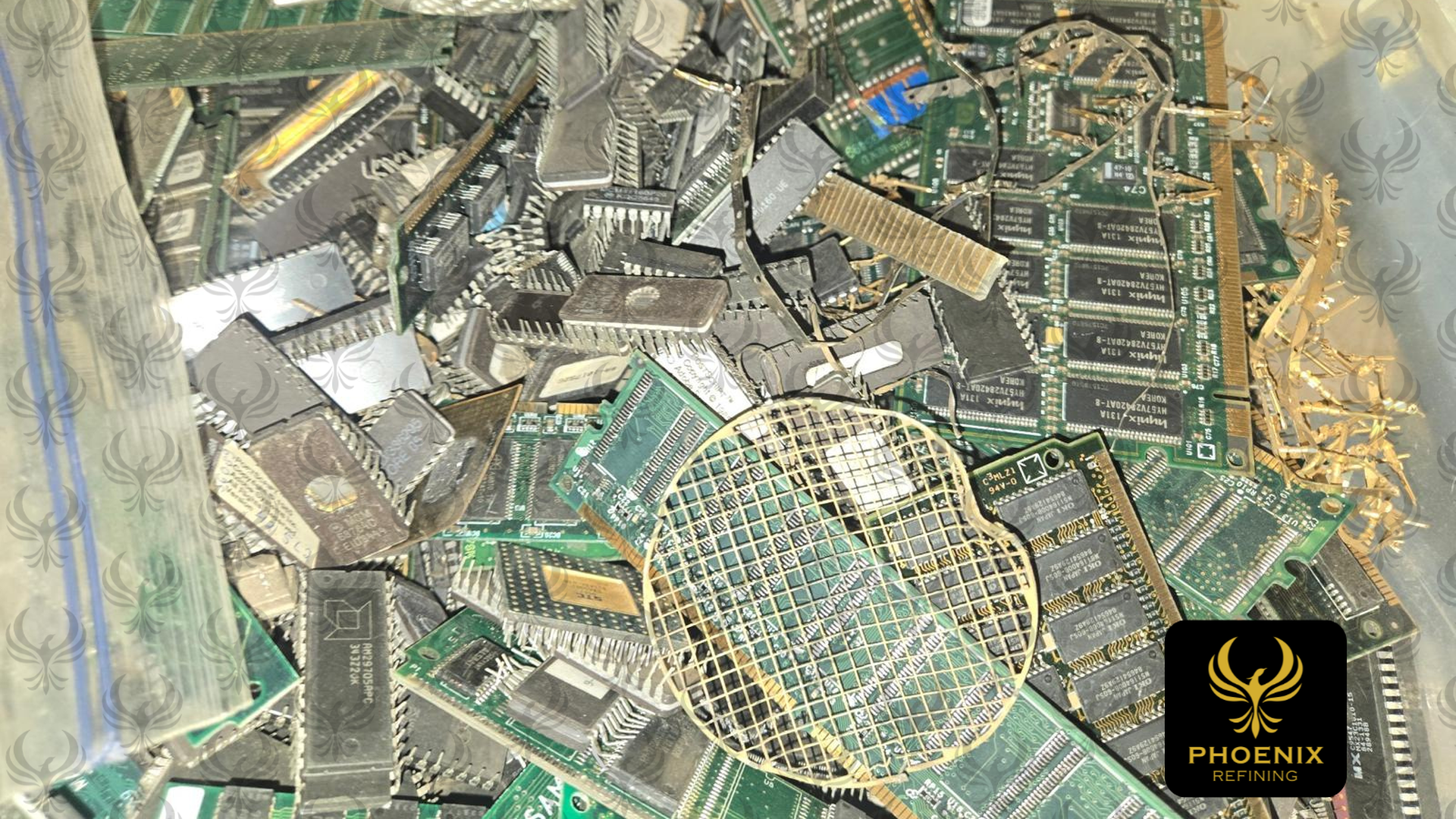
As the world becomes more digital, connected, and electrified, electronic devices are multiplying at an unprecedented pace. Computers, smartphones, routers, wearables, household appliances, e-bikes, medical monitors, LEDs, solar panels, and countless smart devices now shape daily life. But this technological expansion has a consequence that is growing just as fast: electronic waste, or e-waste.
E-waste is not just a disposal problem. It is also one of the richest above-ground sources of valuable materials available today. Buried inside discarded electronics are metals essential to modern industry, including gold, silver, palladium, platinum-group metals, copper, and aluminum. Among these, precious metals are especially important because even in very small quantities, they carry extremely high economic value. In this sense, e-waste is not merely rubbish; it is an urban mine.
According to the Global E-waste Monitor 2024, the world generated a record 62 billion kg of e-waste in 2022, equal to 7.8 kg per person. Yet only 22.3 percent, or 13.8 billion kg, was formally collected and recycled in an environmentally sound manner. Since 2010, e-waste generation has been increasing far faster than formal recycling, by almost a factor of five.

This matters because e-waste contains enormous material wealth. In 2022 alone, global e-waste contained 31 billion kg of metals, 17 billion kg of plastics, and 14 billion kg of other materials. The estimated economic value of the metals contained in global e-waste reached USD 91 billion. While bulk metals such as iron, copper, and aluminum dominate by weight, precious metals are among the most valuable materials present. Gold alone accounted for an estimated USD 15 billion in value, while palladium contributed around USD 8 billion, silver USD 0.9 billion, and rhodium USD 2.3 billion.

These figures reveal a striking reality: some of the world’s most valuable metal resources are already circulating through households, offices, and industries as electronic products, only to be lost when devices are improperly discarded.
Precious metals in e-waste are found in relatively small quantities, but their importance is outsized. They are essential because of their conductivity, corrosion resistance, and performance in miniaturized electronic systems. They are especially common in printed circuit boards, connectors, integrated circuits, mobile phones, computers, and telecommunications equipment.
Globally in 2022, e-waste contained about 1.6 million kg of precious metals, including gold, silver, and palladium, along with smaller quantities of platinum-group metals such as platinum, rhodium, and ruthenium. Although these metals are present in much lower quantities than iron or aluminum, their value per kilogram makes them a key target for recycling.
The report estimates that about 300,000 kg of precious metals and platinum-group metals were converted into secondary resources through formal and informal recycling practices in 2022. That is significant, but it also implies that a large share of these valuable resources is still being lost through poor collection, dumping, incineration, landfilling, and substandard recycling.
Recovering precious metals from e-waste is often described as urban mining, and for good reason. In many cases, discarded electronics contain higher concentrations of valuable metals than natural ores extracted from the earth. Recovering metals from old devices can therefore reduce dependence on traditional mining, avoid environmental destruction, and strengthen supply security.
The benefits are substantial. Current global e-waste management avoids extracting 900 billion kg of ore and prevents 52 billion kg of CO2-equivalent emissions by recycling metals rather than primary mining. It also contributes to a more circular and resilient materials economy.
When precious metals are successfully recovered from e-waste, they reduce the need for new extraction from often environmentally intensive and geopolitically concentrated mining operations. This is especially important at a time when global demand for high-performance materials is rising through digitalization, renewable energy systems, and advanced electronics.
Only a fraction of e-waste reaches formal recycling systems. The report identifies four major e-waste management routes. The first is formal collection and recycling, the preferred route, where e-waste is collected separately and processed in specialized facilities. The second is disposal in residual waste, where e-waste is thrown in household bins and ends up in landfills or incinerators. The third is collection outside formal systems in countries with developed infrastructure, where devices are handled by scrap dealers or informal commercial channels, often recovering some metals but without proper depollution. The fourth is the collection outside formal systems in countries with underdeveloped infrastructure, where informal workers dismantle and process devices manually, often using dangerous methods such as open burning or acid leaching.
In 2022, only 13.8 billion kg of e-waste entered formal systems. Meanwhile, 16 billion kg was collected and recycled outside formal systems in high- and upper-middle-income countries, 18 billion kg was handled largely by the informal sector in low- and lower-middle-income countries, and 14 billion kg was disposed of as residual waste. These patterns lead to major losses of precious metals. Informal recycling often focuses only on easily recoverable, high-value fractions, while more complex and hazardous components are dumped or burned. This reduces overall recovery efficiency and exposes workers and communities to toxic substances.
Some precious metals can be recovered at very high rates when e-waste is processed in the right facilities. Palladium, for example, is used mainly in printed circuit boards and can achieve recycling rates of 95 percent or more when sent through specialized copper smelter routes. Gold and silver can also be efficiently recovered using advanced metallurgical processes.
Yet globally, recovery remains constrained by poor collection and weak infrastructure rather than by a lack of metal value. The main obstacle is getting precious-metal-rich devices into the right recycling stream in the first place. This is why the gap between potential and actual recovery is so large. Of the USD 91 billion in metal value present in global e-waste in 2022, current e-waste management recovered only about USD 28 billion in secondary raw materials. The rest was largely lost due to incineration, landfilling, informal treatment, and inefficient processing.
Precious metals in e-waste represent one of the clearest examples of the contradiction at the heart of the digital economy. The same technologies that promise progress also generate a rapidly expanding waste stream. Yet inside that waste stream lies extraordinary value.
Gold, silver, palladium, and other precious metals are already above ground, embedded in discarded phones, computers, routers, and countless other devices. In 2022, the world’s e-waste held tens of billions of dollars in metal value, but most of it was not recovered through safe and efficient systems. Instead, much was lost through poor collection, informal processing, or disposal. The challenge, then, is not simply to recycle more. It is to recognize e-waste as a strategic resource. Precious metals recovery must move from being a side benefit of waste management to a central pillar of circular economy policy. If governments, industries, and consumers treat e-waste as an urban mine rather than a nuisance, the result could be reduced environmental harm, improved public health, stronger supply chains, and a far more sustainable materials future. In the end, the easiest solution is still to generate less e-waste in the first place. But for the e-waste the world already produces, recovering precious metals is one of the greatest opportunities we cannot afford to waste.