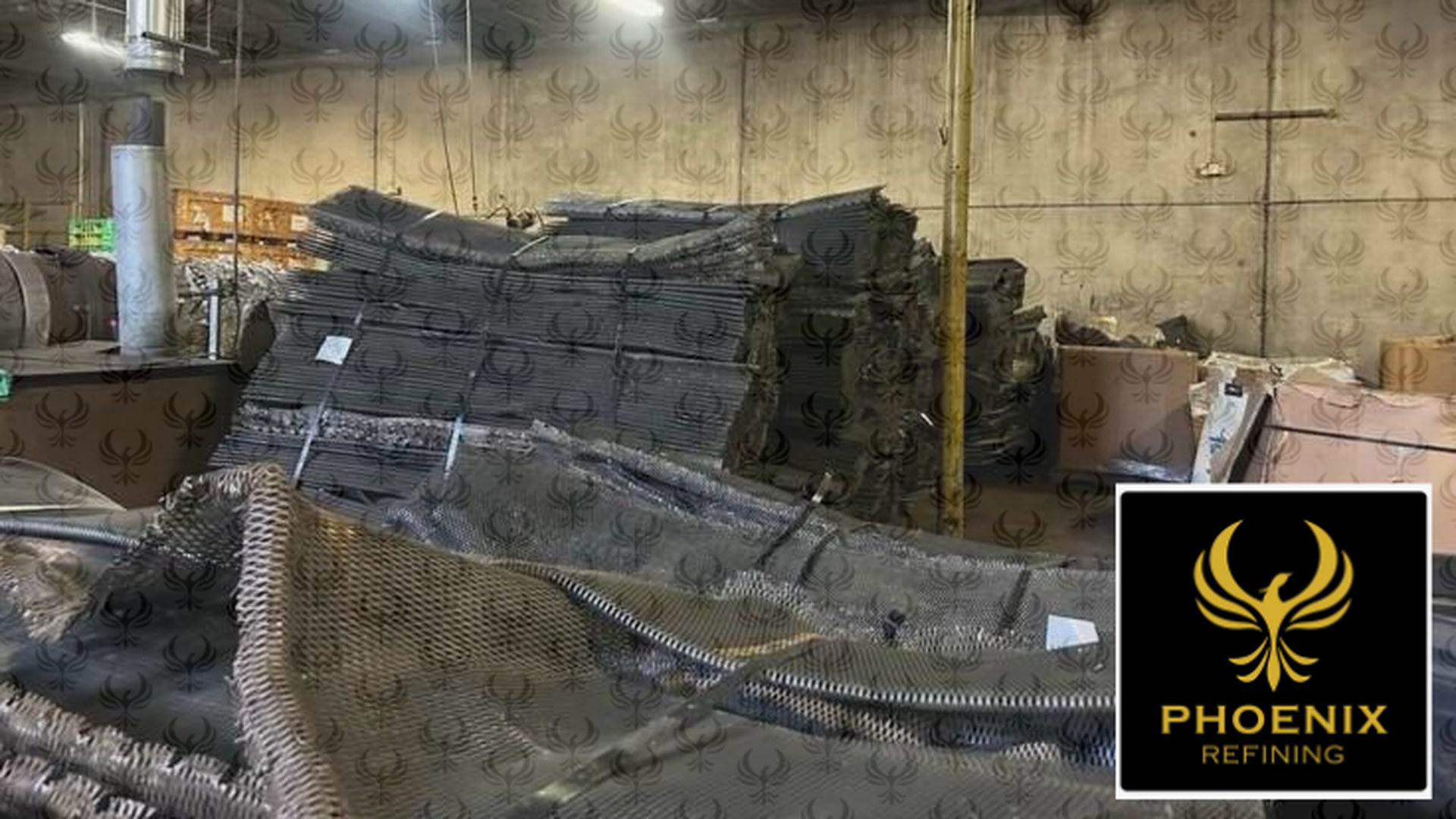
Stopping use of a titanium–ruthenium (Ti/Ru) screen does not mean its economic value has ended, even though its useful electrochemical service has concluded. Developed in the 1960s, these dimensionally stable anodes (DSAs) have replaced consumable graphite electrodes and become an essential component in chlor-alkali production, sodium hypochlorite generation, water treatment, and cathodic protection. The anodes consist of a robust titanium base with a thin, electrocatalytically active mixed-metal-oxide (MMO) coating.
Even if scaling, coating degradation, or substrate passivation makes the screen no longer worth operating, it may still contain recoverable ruthenium and iridium and a titanium structure that can be reused. Assessing these assets before deciding to dispose of the screen can significantly reduce replacement costs. Yet residual value and waste classification are independent judgments: a material may have commercial value and still be treated as hazardous waste. Asset assessment should therefore be conducted alongside the required environmental evaluation, not delay it.
Typical Ti/Ru screens are made of commercially pure titanium coated with ruthenium dioxide and titanium dioxide, sometimes including iridium dioxide or other oxides to increase durability. The coating composition, thickness, and amount of precious metal used depend on the electrolyte type, current density, and intended service life. Although original manufacturing records can provide a good basis for valuation, they do not indicate how much catalyst remains after use. "Terminal scaling" is better viewed as an operational description than a definite diagnosis. Increased cell voltage may result from removable deposits, catalyst depletion, growth of an insulating oxide, or physical damage. Different conditions affect recovery differently.
Although ruthenium dioxide shows strong catalytic activity for chlorine evolution, it can be converted into more highly valued soluble or volatile species under sufficiently oxidizing conditions. Oxygen evolution, especially when local electrolyte conditions are unfavorable, can accelerate catalyst loss. At the same time, electrolyte penetration through coating defects can form an electrically resistive titanium dioxide interlayer. This passivation might render the electrode inoperative even though a considerable amount of precious metal remains. Additional problems may arise from mechanical peeling, damage due to reverse current, and chemical attack in the case of a retired screen. As a result, neither poor performance nor visible scaling indicates that the catalyst has been completely used up. On the other hand, assuming a remaining fraction, such as 30–50% of the original loading, should never substitute for actual measurement.
Evaluation must start with a review of operating history, procurement specifications, maintenance records, and a physical inspection. Operators should record the screen dimensions, titanium grade, original coating formulation, operating conditions, voltage trends, and any exposure to potentially hazardous contaminants. The first technical question is whether the screen is truly exhausted or merely fouled. Where appropriate, manufacturer-approved cleaning and performance testing can determine whether further use is possible. Cleaning must be controlled, since deposits and washings may contain hazardous substances or recoverable catalysts and should not be disposed of without first assessing them.
To carry out a residual-metal valuation, you must take representative samples. Because coating wear is seldom uniform across a screen bank, a measurement taken at one spot that appears to be in good condition may overestimate the amount of metal that can be recovered. X-ray fluorescence calibrated for the purpose can be used for screening. Still, a better basis for settling comes from a competent laboratory analyzing representative samples using a validated preparation and analytical method. Both ruthenium and iridium should be included if they are present. To assess titanium's suitability, separately evaluate remaining thickness, distortion, cracking, pitting, weld integrity, and electrical connections. A screen may still be unsuitable for recoating even though it retains valuable catalyst, or it may be mechanically sound even though it has undergone complete electrochemical deactivation.
The titanium substrate's value is usually maintained for a long time. If the screen were destroyed, the customer would have to incur all costs associated with precision mesh geometry, fabrication, welding, and dimensional control again. When substrate conditions allow, closed-loop refurbishment can preserve this investment. A competent supplier removes the used coating and passivation layer, treats the titanium surface, applies a new MMO coating, and then checks the performance. When assessing savings, compare them with the prices quoted for a new screen, accounting for transport, downtime, rejection rates, expected service life, and the warranty offered. Although claimed savings of 30 to 50 percent may be useful as a preliminary assumption, they are not guaranteed results.
When reuse is not feasible, specialized precious-metal recovery may still be worthwhile. Refractory MMO coatings may necessitate an oxidative alkaline treatment followed by hydrometallurgical separation. Some processes involve volatile ruthenium tetroxide, a highly hazardous substance that requires engineered containment and special controls. This type of processing should take place in facilities properly equipped for it and not in ordinary maintenance workshops. The best option delivers the most favorable lifecycle result, even if it does not have the highest quoted extraction rate.
In the Philippines, assessments must take into account Republic Act No. 6969, DENR Administrative Order No. 2013-22, and current applicable EMB requirements. Material classification is based on its characteristics, the extent of any contamination, and its process history. A spent anode should not be given an electronic-waste code simply because it can conduct electricity. When hazardous-waste controls apply, the generator must still meet responsibilities for authorized transport, permits, manifests, and an appropriately permitted receiving facility. Export for recycling may also trigger the Basel Convention and national requirements. Just because a shipment is described as 'recyclable material' does not mean that hazardous-waste controls are removed or that an exemption is created.
Before making irreversible disposal decisions, consider terminally scaled Ti/Ru coatings as possible secondary resources. Representative tests will show how much metal can be recovered; an engineering inspection will assess the possibility of reusing the substrate; and clear commercial terms will indicate the actual value that can be obtained. When paired with timely regulatory classification, this approach can lower replacement costs, conserve critical metals, and prevent valuable engineered components from being discarded too early.