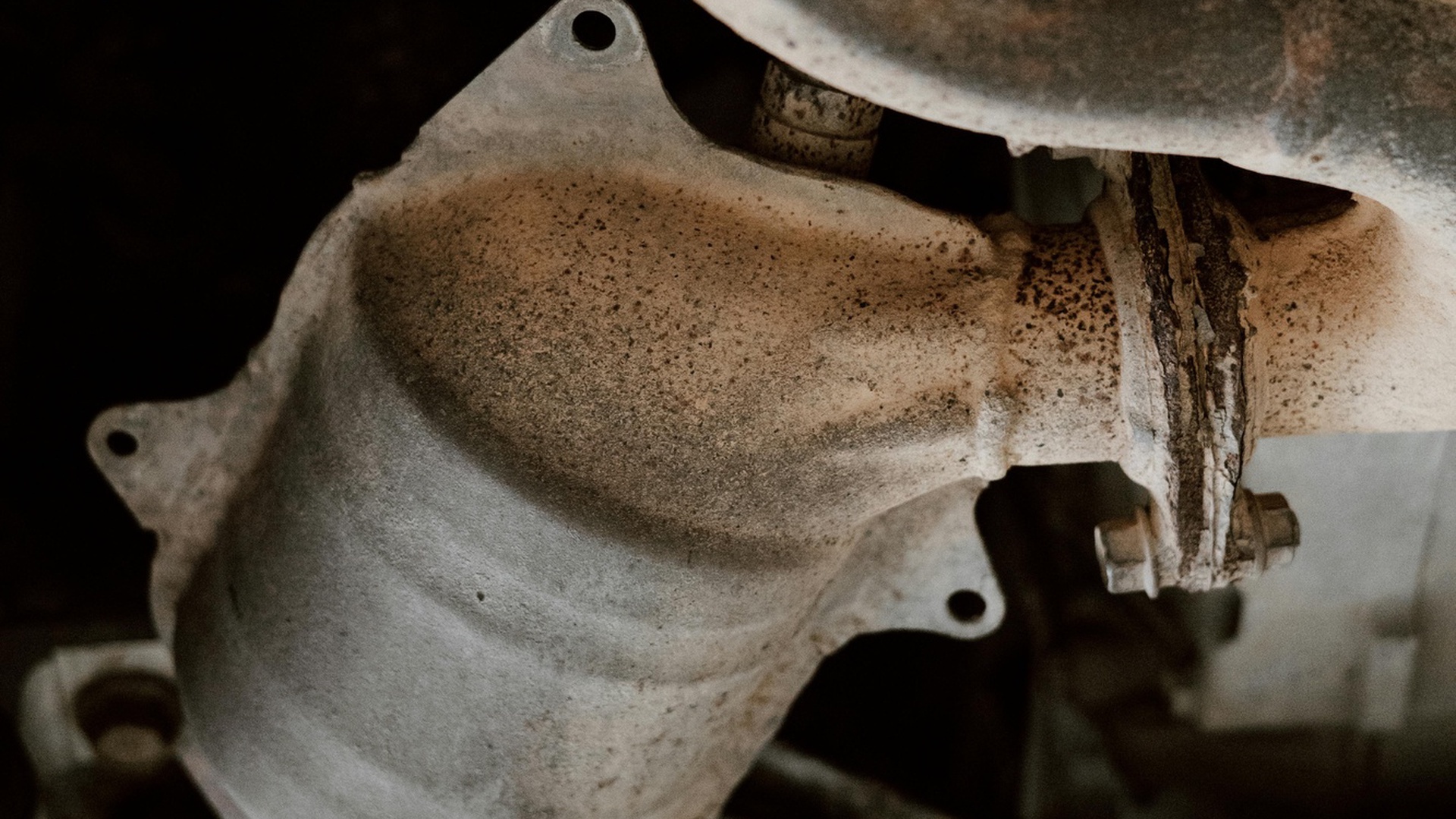
For a long time, most drivers had never even heard of palladium, even though a small amount was actually in the undercarriage of many of their vehicles. It's used in catalytic converters to clean the exhaust from petrol engines. As emissions standards have tightened worldwide, demand for more effective converters has increased, and palladium has become one of the most sought-after materials in the supply chain. By March 2022, palladium had briefly hit around $3,440 an ounce. It was not impossible to buy. The problem was that manufacturers could no longer be confident they could get the physical metal in the quantities they needed, when they needed it, or at a price they could predict. A sustained imbalance between supply and demand had turned a fairly obscure industrial metal into a source of real market stress.
A three-way catalytic converter deals with the three main components of gasoline engine exhaust. Pd and Pt convert toxic CO and unburnt hydrocarbons into CO₂ and water. Rhodium converts nitrogen oxides to nitrogen. The metals are fine particles deposited on a porous coating within a ceramic honeycomb. The structure ensures that as much catalytic surface as possible is exposed to the exhaust stream. The converter must be built to last for years under the high temperatures it will face. At high temperatures, Pd can sinter (clump together) and lose surface area available to clean the emissions. One way to achieve this durability is to load the converter with more precious metal at the outset. Over the millions of vehicles produced, even a small amount of extra metal per vehicle will help meet this increased demand.
Governments in the major car markets have progressively tightened the limits on harmful exhaust. The US Tier 3 rules required lower emissions over the vehicle's life. Europe's Euro 6d regime placed much greater emphasis on real-world driving performance rather than laboratory conditions. China's China 6 and India's Bharat Stage VI extended the rules' stringency to two of the world's biggest car markets.
The rules didn't specify a set amount of palladium per car. They did require converters that could work under more severe conditions. As manufacturers redesigned their exhaust systems to meet the rules, demand for palladium stayed very high. EVs with no petrol engine don't need a catalytic converter. Hybrids are a different case. They do produce exhaust. The engine in a hybrid is turned off quite frequently during the run. When the engine is off, the converter can cool down. On restart, the engine may emit some exhaust before the converter has time to heat up enough to handle it. Engineers have several solutions, from engine control changes to exhaust system design changes. Some hybrid converters also have very high precious-metal loadings to help them cope with repeated heating and cooling. That made the move to hybrids far less simple for palladium demand than it first appeared. A vehicle could burn less fuel and still need a very valuable converter.
Palladium supply simply couldn't keep up. A large proportion of the palladium is a by-product of nickel and copper mining in Russia and of mining for platinum group metals in South Africa. You can't just ramp up palladium production in mining very significantly without changing the amount of ore you're mining and processing for nickel and copper. New mining capacity also takes years to come online.
Production was highly concentrated in a small number of regions. Labor problems and power shortages beset the South African mines. The invasion of Ukraine by Russia in 2022 added a layer of uncertainty around the movement and financing of Russian metal. For OEMs relying on a consistent supply, disruption risk mattered as much as the amount of palladium in the ground. As demand outstripped new supply coming online, buyers drew down existing stocks. The shortage showed up in how palladium traded: borrowing physical metal became increasingly expensive, and, at times, immediately available metal cost more than metal promised for later delivery. That's the phenomenon of backwardation, and it tells you buyers are placing a very high value on the supply they can access right now. An automaker can't run an assembly line with a promise of palladium for next year. It needs a converter for each vehicle it's building today. That urgency drove prices up and made it very difficult to get physical metal.
The price spike also made the catalytic converters that were already in cars a very attractive target. The converters contain palladium, platinum, and rhodium, and they're very easy to remove if they're exposed. Converter thefts in the US rose sharply during the period of very high precious metal prices, with repair costs for a vehicle owner potentially running into the thousands. It wasn't just opportunistic theft, either. In 2022, U.S. authorities launched a nationwide investigation into a network accused of buying and trafficking stolen converters on a massive scale. That case clearly showed how a global commodity squeeze can end up with individual drivers in their own parking lots and driveways.
Eventually, the high prices changed the industry. Catalyst manufacturers developed designs that let them substitute some platinum with palladium, and OEMs worked on ways to use the precious metals more efficiently. That took time, of course, as a new converter had to be tested and certified as part of the vehicle's emissions system. Recycling also brought palladium back into the market from scrap converters. In parallel, rising BEV production was starting to put a floor under long-term demand for gasoline engine converters. All of that contributed to a very significant fall in palladium prices from their 2022 peak.
Palladium became very hard to get as demand for cleaner exhaust from gas vehicles outstripped a concentrated, inflexible mining industry's ability to respond. Supply problems and buyers wanting the metal now rather than later exacerbated the crisis.
The market eventually got around it via substitution, recycling, and changes to vehicle technology. The palladium squeeze remains a striking example of the pressure a small component in such a vast array of products can place on a scarce global resource.