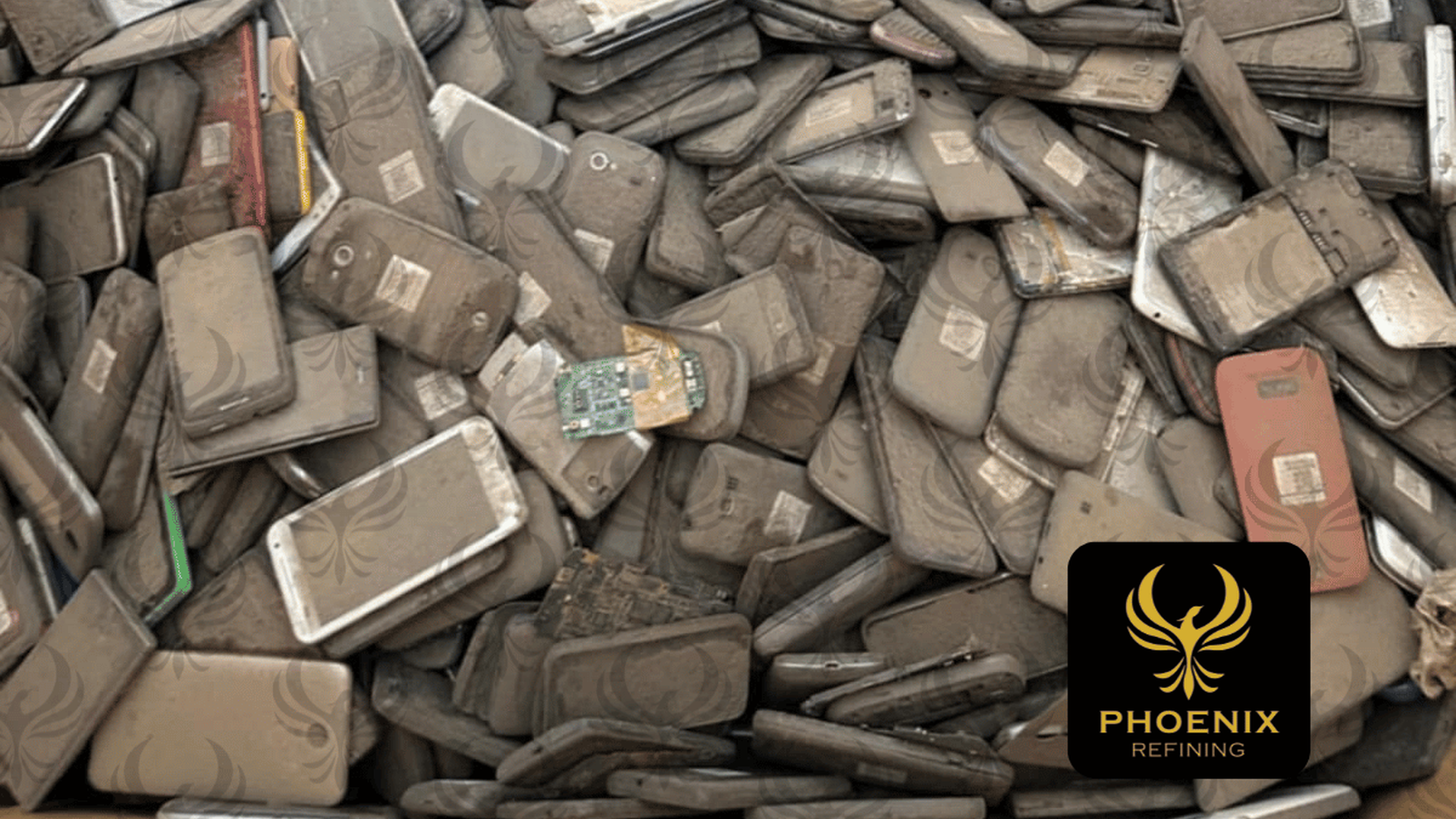
What if the world were sending hundreds of millions, and in reality billions, of dollars’ worth of metals to landfill every year? That is exactly what is happening through electronic waste, or e-waste. As households and businesses replace phones, laptops, televisions, appliances, and industrial electronics at an ever-faster pace, the volume of discarded devices continues to rise. Yet only a small share is properly recycled, leaving a vast reservoir of valuable materials buried in landfills or lost through inadequate treatment.
Electronic waste is not just a disposal problem. It is also an urban mine: a concentrated secondary resource containing base and precious metals, including copper, gold, silver, nickel, and palladium. Recovering these metals can reduce the need for primary mining, lower greenhouse gas emissions, improve resource security, and help offset the cost of recycling itself. As technologies for metal recovery improve, e-waste is increasingly being recognized not as rubbish, but as one of the most promising feedstocks for the circular economy.
E-waste refers broadly to discarded products containing electronic components, ranging from household appliances and consumer electronics to IT equipment and commercial machinery. It is classified as hazardous waste because it often contains toxic substances, including mercury, lead, and brominated flame retardants. Its composition is highly complex: plastics, ceramics, glass, resins, solders, and a wide range of metals are tightly integrated into compact assemblies. This makes collection, dismantling, and treatment expensive and technically challenging.
The scale of the issue is enormous. According to the Global E-waste Monitor 2024, the world generated 62 million tonnes of e-waste in 2022. Of this, around 14 million tonnes were dumped in landfills. Although e-waste management currently recovers about USD 28 billion in secondary raw materials, the potential value is estimated at USD 91 billion. Most of this unrealized value is lost through landfilling, incineration, and inadequate recycling practices. Only 22.3% of e-waste was formally collected and recycled in 2022, though regions with stronger regulation, such as Europe, performed better, with 42.8% formally collected and recycled.
This poor recovery rate has both economic and environmental consequences. When metals are not recovered from discarded electronics, additional mining and refining are required to meet industrial demand. As ore grades decline globally, primary production is becoming more energy-intensive and costly. In that context, e-waste represents both a problem and an opportunity: a hazardous waste stream on one hand, and a high-value metal resource on the other.
Much of the recoverable value in e-waste lies in printed circuit boards, or PCBs, which contain the highest concentration of precious and base metals. These boards are found in phones, computers, televisions, appliances, and countless other devices. Their metal content varies significantly depending on the type of equipment.
E-waste is often grouped into four broad categories. Category 1 includes large household appliances such as fridges, washing machines, air conditioners, and stoves. Category 2 includes smaller appliances such as microwaves, toasters, and vacuum cleaners. Category 3 covers IT and telecommunication equipment such as computers, phones, and tablets. Category 4 includes consumer electronics such as TVs, monitors, cameras, speakers, and audio equipment.
These categories help estimate PCB grade and metal content. In general, Category 1 and Category 2 contain lower-grade PCBs, while Category 3 and Category 4 contain higher-grade PCBs with much greater precious-metal value. Among these, Category 3 devices, especially phones and computing equipment, tend to have the highest gold content.
Based on estimated PCB quantities, market values, and reported metal concentrations, the total potential metal recovery from the e-waste market is currently valued at around USD 37 billion, with e-waste volumes projected to grow by roughly 3.7% annually. In value terms, the greatest opportunities lie in palladium, gold, copper, and silver, which together account for about 96% of the value of the non-ferrous focus metals in PCBs. This helps explain why e-waste recycling is no longer seen solely as a compliance or environmental issue. It is also a resource recovery business. If metals can be extracted efficiently and to high purity, they can be reused in manufacturing or sold directly, improving the economics of e-waste processing.
Despite its value, e-waste is difficult to process. Devices vary enormously in size, design, and material composition. A refrigerator, smartphone, television, and industrial control unit all contain different materials arranged in different ways. This means there is no single recovery process suitable for every device. Instead, e-waste recycling typically involves several stages, beginning with collection and disassembly, followed by mechanical separation, and finally metallurgical extraction.
Research increasingly emphasizes the importance of integrated, multi-material recovery rather than focusing solely on metals. Lima et al. (2022), for example, discuss strategies that combine recovery of metals with polymeric fractions, improving overall resource efficiency. Likewise, improved identification and sorting technologies, as highlighted by Chaine et al. (2025), can reduce unwanted incineration and improve circular economy outcomes by sending more components into appropriate recovery streams.
The first step in e-waste recycling is usually disassembly. Devices are broken down into smaller components, and hazardous parts are removed. Materials are then sorted into streams, including reusable components, metal-rich fractions, plastics, and PCB concentrates. At present, much of this work is labor-intensive and often done manually. However, automation is beginning to play a greater role. Apple’s “Liam” and “Daisy” robots, for example, are designed to disassemble iPhones and recover reusable components more efficiently. Similar advances in robotic sorting could reduce costs and improve throughput in the future.
After disassembly, materials are physically processed through shredding, grinding, or pulverizing. The goal is to reduce devices to smaller particles so that their physical properties can be used to separate. In some cases, the deformation that occurs during shredding helps distinguish metals from non-metals, since malleable metals may become more spherical while non-metallic particles remain irregular. Density-based liquid sorting can also be used, with denser metallic fractions sinking and lighter non-metallic fractions floating. Electrostatic separation exploits differences in electrical conductivity to separate conductive from non-conductive materials, while magnetic separation is applied to remove ferrous components before or during crushing.
These methods are essential for upgrading PCB-rich fractions before metal extraction. However, they also have important limitations. They can lead to losses of precious metals, often do not produce metals at high purity, and can be energy-intensive. Their efficiency is also highly sensitive to particle size, shape, and feed consistency. For these reasons, physical separation is generally viewed as a preparation stage rather than a complete recycling solution.
One of the most promising recent developments in e-waste recycling comes from researchers at Flinders University in Australia, who have developed a safer and cleaner method for recovering gold from electronic waste. Gold is especially valuable in electronics because it is highly conductive, corrosion-resistant, and infinitely recyclable without losing performance. Even though each device contains only a small amount, the total adds up quickly. A single iPhone contains roughly 0.034 grams of gold. Scaled across global e-waste flows, the recoverable quantity becomes significant. It is estimated that recycling one million smartphones can yield about 34 kilograms of gold, worth well over AUD 3 million at current prices.
Traditional methods for gold recovery, such as cyanide leaching or aqua regia, are effective but highly toxic, dangerous to handle, and difficult to manage safely. The Flinders method offers a more sustainable alternative. It uses a water-based process involving a benign organic molecule called β-cyclodextrin, which selectively binds to gold ions in solution. Acting as a molecular host, it separates gold from other metals in shredded circuit boards at room temperature.
According to the researchers, the process can recover up to 99% of gold from printed circuit boards without generating toxic by-products. It is biodegradable, low-energy, and potentially scalable. The team has suggested it may be commercially viable within the next five years. This matters not just scientifically, but strategically. Australia is one of the world’s leading gold producers, yet the future of gold supply is likely to include both mined and recycled sources. Safe, selective recovery methods could support decentralized recycling operations, reduce reliance on offshore processing, and create new industries in advanced materials recovery. Gold’s durability and infinite recyclability make it especially well-suited to a circular economy.
Technology alone will not solve the e-waste challenge. Policy and product design are equally important. Governments are increasingly exploring extended producer responsibility approaches, in which manufacturers are required to collect and recycle their own products or contribute financially to treatment costs. The logic is straightforward: if producers bear some of the end-of-life cost, they will have a stronger incentive to design products that are easier to dismantle, repair, and recycle.
Consumer behavior also matters. Experience shows that when e-waste collection is convenient and well-publicized, participation rises significantly. Public education, take-back programs, retail collection points, and municipal drop-off systems all help divert electronics away from landfills.
At the same time, product design must evolve. Many modern electronics are compact, glued, soldered, and assembled in ways that maximize performance and minimize manufacturing cost, but make disassembly difficult. Designing for recyclability through modularity, standardized fasteners, better labeling, and reduced material complexity could dramatically improve recovery rates.
Electronic waste embodies a paradox. It is one of the fastest-growing and most problematic waste streams in the world, yet it is also one of the richest untapped sources of recoverable metals. In 2022 alone, humanity generated 62 million tonnes of e-waste, enough to fill more than 23,000 Olympic-sized swimming pools. Much of it was lost to landfill, incineration, or poor treatment, despite containing billions of dollars’ worth of copper, gold, silver, palladium, and other valuable materials.
Recovering precious and base metals from e-waste offers clear benefits. It reduces pressure on mining, lowers emissions, recovers economic value, and supports the transition to a circular economy. But achieving this potential requires better collection systems, smarter sorting, more selective recovery technologies, and stronger policy frameworks.
Both pyrometallurgical and hydrometallurgical routes have roles to play, each with strengths and limitations. Smelting remains effective for large-scale processing but is energy-intensive and carbon-heavy. Digestion and electrowinning offer cleaner, faster, and potentially more decentralized alternatives. Meanwhile, emerging innovations such as β-cyclodextrin-based gold recovery demonstrate that safer, greener approaches are becoming technically feasible. Urban mining is no longer a futuristic concept. It is an economic and environmental necessity. If industry, government, and researchers can align on better systems for recovery, e-waste can shift from a global liability to one of the most important resource streams of the twenty-first century.