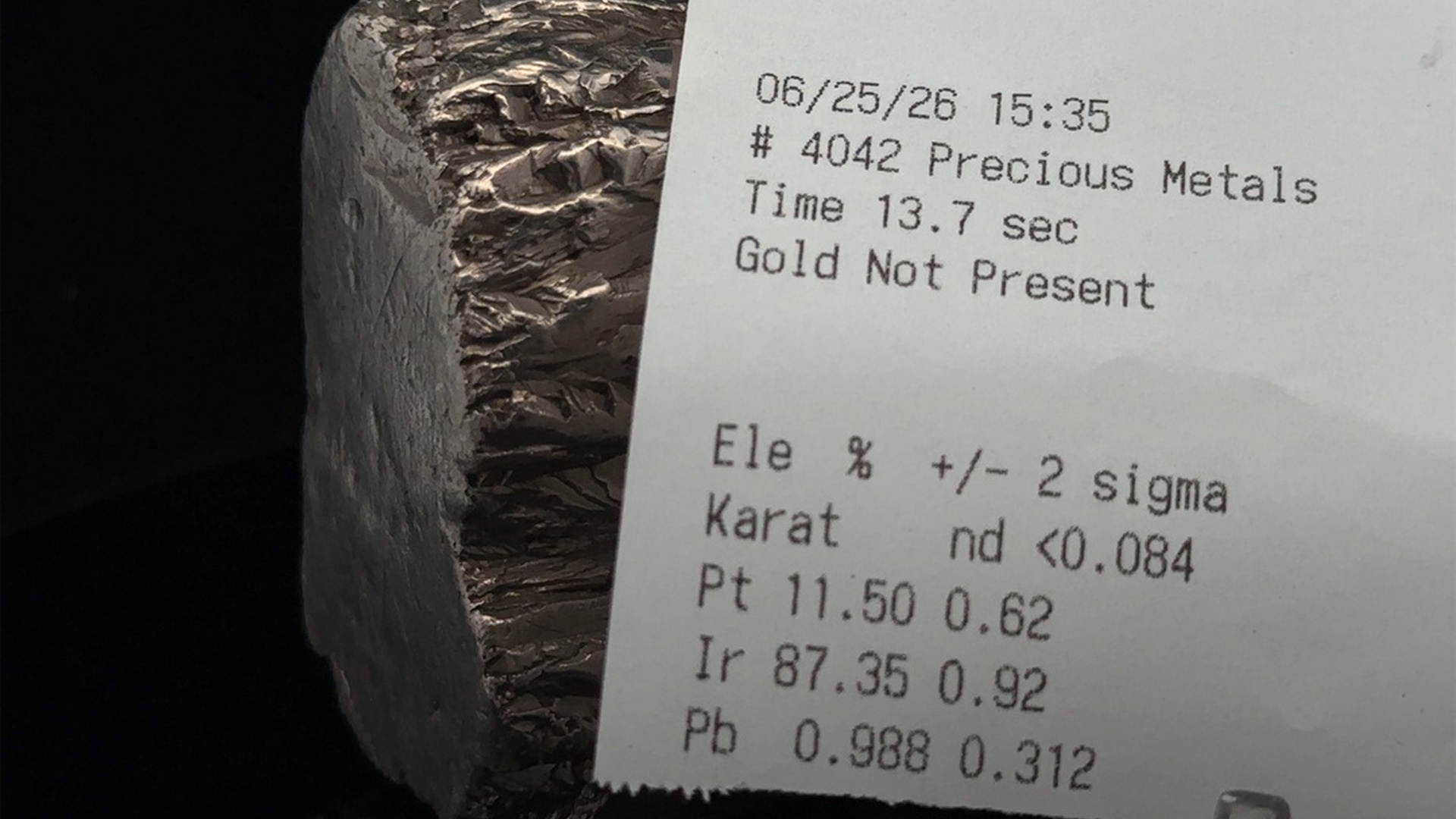
Iridium is one of the rarest and most valuable metals used by modern industry. Its density of approximately 22.56 grams per cubic centimeter, melting point near 2,446°C, and exceptional corrosion resistance make it ideal for demanding applications such as high-performance spark plugs, proton-exchange membrane electrolyzers, precision alloys, medical devices, electrical contacts, and high-temperature crucibles. Those same properties make iridium unusually difficult to recover and measure.
For scrap sellers, the central problem is not simply determining whether a component contains iridium but establishing exactly how much it contains. Two visually similar components may have dramatically different compositions, and an unsuitable assay can underreport the metal present. Verification must therefore precede a seller's commitment to refine an entire lot.
Iridium is extraordinarily scarce in Earth’s accessible crust, with an estimated abundance of approximately 0.000022 parts per million. Most of the planet’s iridium sank into its metallic core during formation, leaving only trace quantities near the surface. Annual primary production is commonly estimated at 5.5 to 7.9 metric tons, with more than 85% of that associated with South African platinum-group-metal production.
Iridium is also produced almost entirely as a byproduct of platinum and palladium mining. Supply cannot be expanded quickly in response to demand, while primary ores may contain less than 0.003% iridium. Recovering it requires extensive crushing, concentration, smelting, and chemical separation. Consequently, recycling end-of-life industrial components is an essential part of the global supply chain. The value of this secondary material, however, hinges on accurate identification and measurement.
Pure iridium is usually not used in finished products. It is brittle, difficult to machine, and may form volatile oxides under certain high-temperature conditions. Manufacturers instead alloy it with rhodium, platinum, ruthenium, rhenium, tungsten, zirconium, and other materials. In catalytic applications, it may be present as iridium oxide or as microscopic particles dispersed over a support.
This produces enormous compositional variation. The amount of iridium in a scrap lot can depend on the manufacturer, product generation, engineering requirements, operating history, and degree of wear. Gross weight, appearance, and historical specifications are not reliable substitutes for testing. Recovered firing pins from mixed spark-plug batches may therefore contain approximately 50% to 98% iridium by weight. That percentage applies only to the isolated electrode material, not the complete plugs. A valuation based on gross plug weight or a presumed yield can easily miss the lot’s actual value.
PEM electrolyzer scrap presents an even more complicated example. Iridium or iridium oxide is used as the anode material because it can withstand the acidic and oxidative conditions of the oxygen evolution reaction. Older electrolyzers frequently used relatively high catalyst loadings, while newer systems have undergone aggressive “thrifting” to reduce their dependence on scarce iridium.
A square meter of a legacy membrane electrode assembly might contain 20 to 30 grams of iridium. A modern, highly thrifted assembly of similar size may contain only 2 to 4 grams. New catalyst systems may also combine iridium with ruthenium or disperse extremely small quantities over titanium-based supports. Because the catalyst is integrated with polymers, titanium layers, carbon materials, and other substrates, its content cannot be judged visually or through equipment dimensions alone.
Platinum-iridium alloys also vary substantially. Workable grades used in wires, jewelry, and medical components may contain approximately 5% to 10% iridium. Electrical contacts and wear-resistant parts may contain 15% to 20%, while high-temperature crucibles and demanding industrial components may contain 25% to 30%. Assuming that a large component contains 10% iridium when it actually contains 30% can result in a severe undervaluation.
An assay is only useful when its method is appropriate for the material. Traditional lead-fire assay is highly effective for gold and silver, but it can be unreliable for iridium and other refractory platinum-group metals. During lead fire assay, molten lead collects precious metals from a fused sample. The lead button is then cupelled in an oxidizing environment, leaving a small bead of precious metal. Iridium’s high melting point and refractory behavior may prevent it from consistently dissolving in the lead collector. During cupellation, some iridium may also form volatile oxide species or be absorbed into the cupel. The resulting assay can report less iridium than the sample actually contained.
X-ray fluorescence, or XRF, has different limitations. It is fast, nondestructive, and useful for screening clean, homogeneous alloys, but it measures primarily near the sample’s surface. Oxidation, coatings, contamination, ceramic housings, polymer membranes, titanium layers, and uneven catalyst distribution can distort the result. Testing a single accessible point does not necessarily represent the entire mixed batch.
For complex iridium scrap, reliable analysis begins with representative sampling and thorough preparation. The material may need to be dismantled, crushed, ground, blended, or chemically digested. One established approach is nickel sulfide fire assay, which captures refractory platinum group metals in a nickel sulfide bead rather than relying on lead collection and cupellation. The collected metals can then be separated, dissolved, and measured using inductively coupled plasma mass spectrometry or optical emission spectroscopy. These instruments provide the sensitivity required for both high-grade alloys and heavily thrifty catalyst materials.
A proper assay establishes the amount of iridium and other precious metals present, but sellers should also review the commercial terms attached to that result. Contained metal is not always identical to payable metal. Moisture deductions, nonmetallic substrates, recovery percentages, processing charges, minimum lot requirements, and the chosen market-price date can all affect the final settlement. The safest approach is to inventory and separate material by type, manufacturer, age, or known grade before selecting a representative sample. The seller should then confirm that the laboratory uses methods suitable for refractory platinum group metals. The full refining lot should be committed only after reviewing the verified composition, payable percentages, charges, and pricing terms.
Sellers seeking that information before making a decision can send representative sample batches to Phoenix Refining for free testing, accompanied by a correctly completed shipping form and accurate inventory. The comprehensive testing process generally takes two to three weeks after receipt. If we identify valuable metals, Phoenix Refining can provide a purchase offer based on the verified content and applicable market value. Because advanced assays are destructive, submitted samples are not returned, making representative selection especially important.
Iridium scrap cannot be valued reliably by appearance, component count, gross weight, or generalized recovery assumptions. Its true worth depends on careful sampling and appropriate analytical chemistry. In a market where a small difference in reported concentration can represent substantial value, verification is not merely a technical formality. It is the seller’s primary safeguard against underpayment.