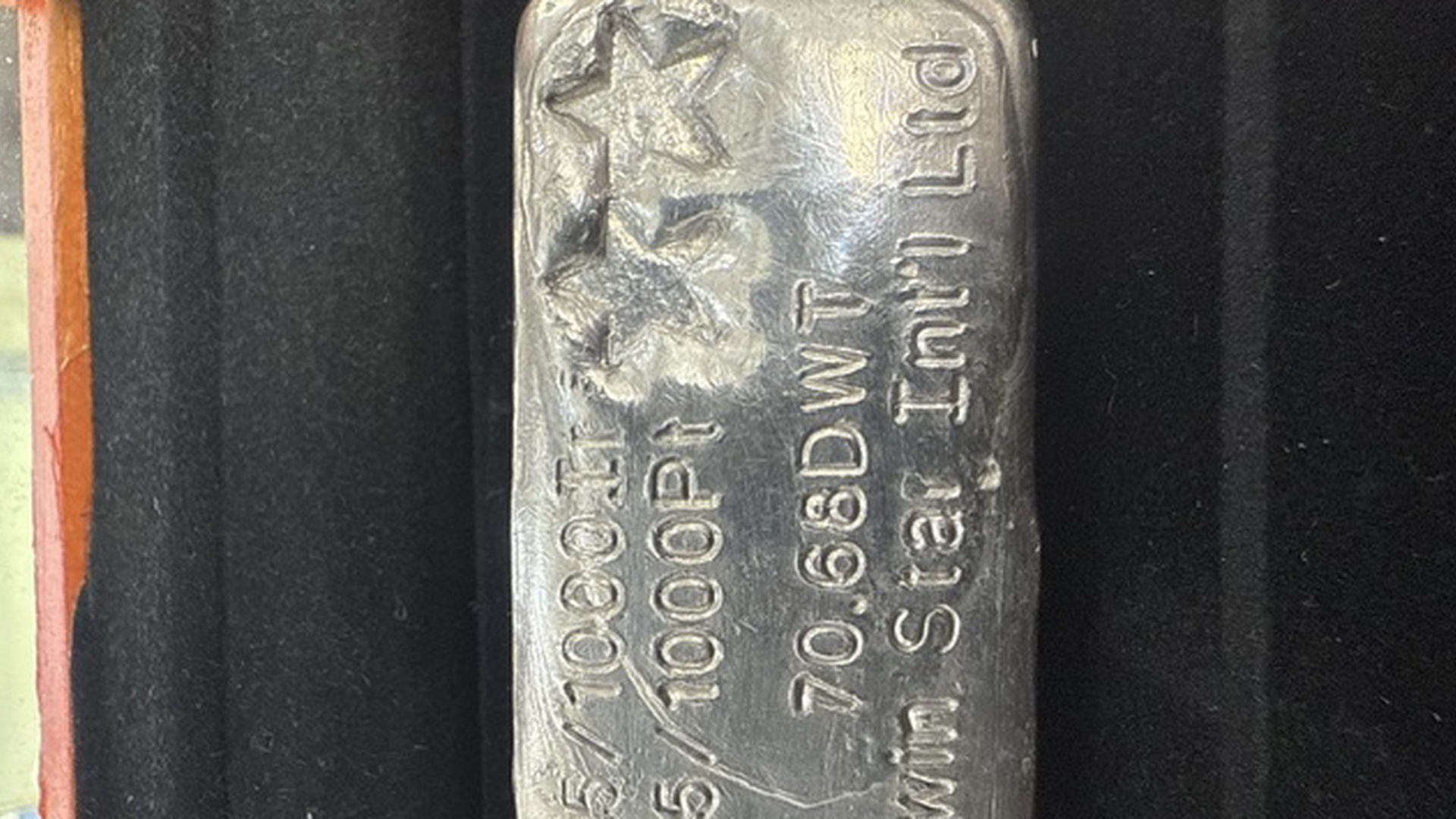
Iridium is so scarce that annual worldwide production has historically been measured in only a few tons. During the 1990s and early 2000s, mines typically produced between 2.2 and 4.9 tonnes each year, giving rise to the often-repeated claim that global production is only three tonnes annually. Modern output has increased, but only modestly: worldwide, a typical year now recovers approximately seven to eight tonnes of primary iridium. That entire quantity could fit comfortably in the back of a pickup truck.
Even at today's higher production level, iridium remains one of the rarest stable elements obtained from Earth. Its scarcity is more than a geological curiosity. The metal is indispensable in technologies ranging from green-hydrogen electrolyzers and OLED displays to chemical catalysts, aircraft components, and cancer treatments. As demand grows, iridium may become a significant physical bottleneck for parts of the industrial economy.
Iridium's rarity at the surface can be traced to the planet's formation. It is a highly "siderophile," or iron-loving, element. When the young Earth was largely molten, iridium preferentially dissolved in liquid iron, and as that iron sank and formed the planet's core, most of Earth's iridium was carried along with it. The mantle and continental crust were consequently left severely depleted. The average concentration of iridium in the crust is estimated at only about 0.001 parts per million. Much of the small amount now present near the surface may have arrived through meteorites during later periods of bombardment. Meteorites commonly contain far more iridium than terrestrial rocks, a difference that helped scientists explain one of the greatest mass extinctions in the geological record.
In the late 1970s, geologist Walter Alvarez found an unusual layer of clay at the boundary between Cretaceous and Paleogene rocks in Gubbio, Italy. Tests conducted with his father, physicist Luis Alvarez, and chemists Frank Asaro and Helen Vaughn Michel revealed an exceptionally high concentration of iridium. Similar deposits were subsequently discovered around the world. Because iridium is scarce in Earth's crust but relatively abundant in asteroids, the researchers proposed that a giant impact had spread iridium-rich dust across the planet approximately 66 million years ago. The impact, associated with the 180-kilometer-wide Chicxulub crater in Mexico, threw aerosols, dust, and soot into the atmosphere, reduced sunlight, and contributed to the extinction of roughly three-quarters of Earth's species, including the non-avian dinosaurs. Iridium thus became both an industrial metal and one of geology's most famous markers.
Iridium, element 77 on the periodic table, is a silvery-white member of the platinum-group metals. With a density of about 22.56 grams per cubic centimeter, it is second only to osmium among naturally occurring elements. It melts at approximately 2,446°C and retains excellent mechanical properties in oxygen-rich environments at temperatures where most metals rapidly weaken or oxidize. Its defining characteristic is extraordinary corrosion resistance. Iridium withstands air, water, and most common acids. Even aqua regia, the mixture of nitric and hydrochloric acids capable of dissolving gold and platinum, does not readily attack solid iridium under ordinary conditions.
These qualities make iridium valuable, but they also make it difficult to process. Despite having a crystal structure normally associated with ductile metals, it is extremely hard and brittle at room temperature. Components often must be produced through powder metallurgy or hot-worked at temperatures between approximately 1,200°C and 1,500°C. Refining the metal is similarly demanding. No primary iridium mines exist; it is recovered in trace quantities while mining platinum, palladium, nickel, and copper. Ore must be crushed, concentrated, smelted, and chemically treated to remove base metals. Platinum, palladium, and gold are then separated before iridium can be isolated from residues containing other minor platinum-group metals. The process can take months and requires specialized facilities, aggressive chemicals, and considerable energy.
Around 80% or more of the world's primary iridium originates in South Africa's Bushveld Igneous Complex, an enormous geological formation that contains most known platinum-group-metal reserves. Smaller quantities come from Russia's Norilsk-Talnakh nickel and copper deposits, Zimbabwe's Great Dyke, and Canada's Sudbury Basin.
This geographic concentration creates substantial supply risk. Political instability, electricity shortages, labor disputes, sanctions, mine closures, or refinery interruptions in only one or two countries can affect the global market.
More importantly, iridium supply is highly inelastic. Because the metal is merely a trace byproduct, a higher iridium price does not necessarily encourage companies to open new mines. Companies mainly base their production decisions on the economics of platinum, palladium, nickel, and copper. Even when iridium prices surge, mines cannot quickly increase output solely to obtain more of it.
South African production is also becoming more complex. Easily accessible deposits have been depleted, forcing operators toward deeper, more expensive ore bodies. Some of these deposits contain a greater proportion of iridium, but extracting them requires greater investment, ventilation, refrigeration, and energy. The result is a rigid supply ceiling that has kept annual primary output within a narrow range.
The most consequential source of future demand may be proton exchange membrane, or PEM, electrolyzers. These devices use electricity to split water into hydrogen and oxygen. Because they can respond rapidly to fluctuating electricity supplies, they are well suited to wind and solar power. The anode of a PEM electrolyzer operates under highly acidic, oxygen-rich, and electrically aggressive conditions. Iridium oxide is presently the only commercially proven catalyst that combines high efficiency with sufficient durability in this environment. No fully viable substitute is available at an industrial scale.
This dependence creates a difficult calculation for the green-hydrogen industry. Conventional PEM systems may require hundreds of kilograms of iridium for each gigawatt of electrolyzer capacity. Rapidly expanding global capacity without reducing catalyst loadings could consume several years of worldwide iridium production. Researchers are therefore developing thinner catalyst layers and more efficient structures that achieve the same performance with much less metal. Iridium is also important in electronics. Its high melting point and oxidation resistance make it suitable for crucibles used to grow sapphire and lithium tantalate crystals. These crystals are used to make components such as surface acoustic wave filters for smartphones and telecommunications systems.
In OLED screens, iridium-based compounds act as phosphorescent emitters. The heavy iridium atom enables the display to convert a much larger share of electrical energy into light than conventional fluorescent materials. By changing the molecules surrounding the iridium center, chemists can produce different colors for efficient televisions, phones, and lighting systems. Other uses include durable spark-plug tips, high-temperature aerospace components, and catalysts for manufacturing acetic acid. The radioactive isotope iridium-192 is employed in industrial radiography to inspect welds and in brachytherapy to deliver concentrated radiation directly to tumors.
A small and inflexible market makes iridium prices extremely volatile. In early 2020, the metal traded near $1,500 per troy ounce. Demand from telecommunications equipment and expectations surrounding green hydrogen helped push prices to approximately $6,000 per ounce in 2021. Such movements illustrate how quickly industrial purchasing or stockpiling can overwhelm a market supplied by only a few tonnes of metal. Mining alone is unlikely to resolve the problem. The most practical responses are "thrifting" using less iridium in each product and closed-loop recycling. Spent electrolyzer membranes, chemical catalysts, and manufacturing materials can be processed so that their iridium is returned directly to production. Recycling requires much less energy than extracting and refining metal from deeply buried ore, and it also reduces dependence on a geographically concentrated supply chain.
Iridium presents a striking paradox. It can help produce low-carbon hydrogen and energy-efficient displays, yet its extraction is energy-intensive and often connected to coal-powered mining operations. Its future will therefore depend not on dramatic expansion in mine production but on better catalyst design, careful recovery, and repeated reuse. The familiar figure of three tonnes per year may no longer describe current production precisely, but it captures the essential reality: iridium exists on an extraordinarily small industrial scale. For technologies that depend on its unmatched properties, every gram matters.