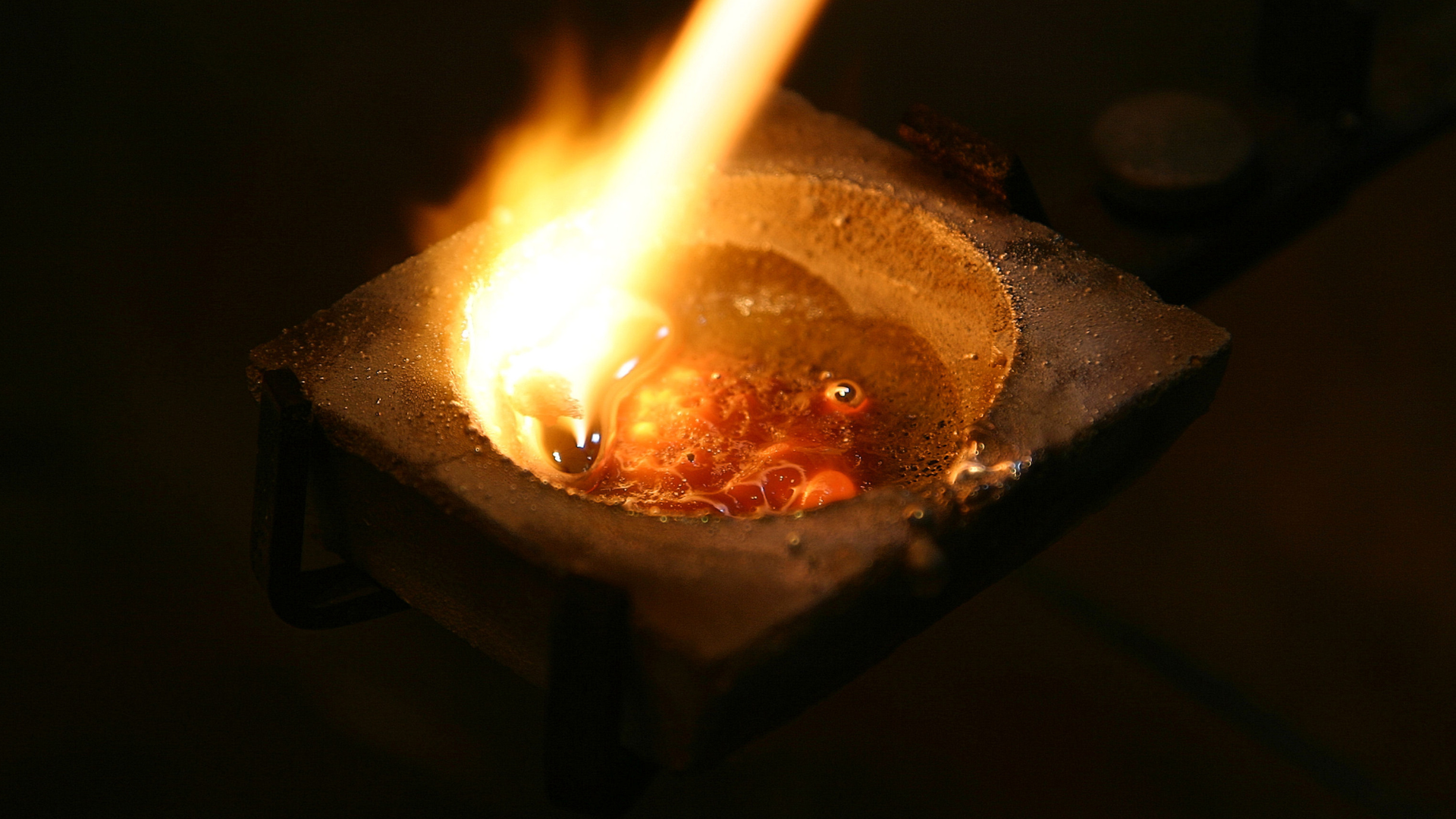
For crystal-growth facilities, advanced photonics manufacturers, medical-imaging suppliers, and research institutions, a retired iridium crucible is not merely worn production equipment. It is a concentrated strategic asset that may be worth hundreds of thousands or well over one million dollars. At iridium market levels of roughly $4,000 to $5,000 per troy ounce, a production crucible weighing between five and ten kilograms can represent gross metal value from approximately $640,000 to more than $1.6 million. At these values, ordinary scrap-handling assumptions become dangerous. A small discrepancy in assay results, sampling methodology, recovery percentage, furnace-loss deduction, or settlement terms can quietly remove tens of thousands of dollars from the seller's return. Retiring and liquidating an iridium crucible therefore requires more than obtaining a buyback quote. It requires understanding the crucible's metallurgy, operating history, accumulated contaminants from crystal growth, the challenges of iridium refining, and the safeguards needed to ensure an accurate, transparent final settlement.
Many people believe iridium crucibles are used mainly in mainstream LED-grade sapphire production. In reality, most high-volume sapphire production for LED substrates relies on Kyropoulos or heat-exchanger growth methods, where refractory crucibles made from molybdenum or tungsten are more commonly used. Iridium's true operational territory is the Czochralski growth of specialized single-crystal oxides that require exceptionally high temperatures and chemically non-reactive containment. With a melting point near 2,446 degrees Celsius and an exceptionally high density of 22.56 grams per cubic centimeter, iridium is one of the few materials that can reliably contain aggressive oxide melts at temperatures exceeding approximately 1,600 degrees Celsius under tightly controlled atmospheric conditions.
High-technology crystal-growth operations most often generate retired iridium vessels. Surface acoustic wave filter manufacturers use iridium crucibles to grow lithium tantalate and lithium niobate crystals for mobile radio-frequency front ends and high-frequency telecommunications systems. Solid-state laser crystal producers use them for materials such as neodymium-doped yttrium aluminum garnet, erbium-doped garnets, and gadolinium gallium garnet. Medical imaging and nuclear physics applications require high-density scintillator crystals, including lutetium-yttrium oxyorthosilicate, lutetium oxyorthosilicate, and gadolinium oxyorthosilicate, all of which are used in technologies such as positron emission tomography scanners. Iridium crucibles also support the development of next-generation wide-bandgap power semiconductors, including beta-gallium oxide, as well as specialty optical sapphire used in military sensor windows, precision optical hardware, and luxury watch crystals. While alumina melts above approximately 2,050 degrees Celsius and therefore operates within a relatively narrow margin below iridium's melting point, many other critical oxides fall more comfortably within iridium's thermal stability range. Lithium tantalate melts near 1,650 degrees Celsius, gadolinium gallium garnet near 1,725 degrees Celsius, and yttrium aluminum garnet near 1,970 degrees Celsius. In these applications, iridium is not simply a premium alternative. It is often the foundational and non-substitutable containment material.
Commercial crystal-growth crucibles are typically fabricated from ultra-high-purity iridium, commonly specified between 99.8 percent and 99.95 percent purity or better. Depending on the fabricator, the metal may also incorporate proprietary grain-stabilized or micro-alloyed structures intended to reduce high-temperature creep, grain coarsening, deformation, and other microstructural deterioration during extended thermal campaigns. Crucible geometry depends on the scale of the crystal-growth operation. Research-scale radio-frequency-heated development vessels may measure approximately 50 millimeters in diameter and weigh less than one kilogram. Larger commercial production vessels used for lithium tantalate wafers, scintillator boules, laser crystals, or specialty optical products can range from approximately 150 to 250 millimeters in diameter, with wall thicknesses generally between 1.5 and 3 millimeters.
A cylindrical production vessel about 150 millimeters in diameter and 150 millimeters high, with a two-millimeter wall and a three-millimeter base, can hold almost four kilograms of iridium despite its modest size. Larger production crucibles commonly weigh from seven to twelve kilograms, placing them squarely in seven-figure value territory. A crucible's active service life is finite. A vessel may withstand tens of continuous crystal-growth runs over one to three years, but repeated heating and cooling cycles eventually create unacceptable structural risk. Retirement commonly occurs when a crucible experiences wall thinning, severe base sagging, localized bulging, thermal-fatigue cracking, grain growth, creep, melt-line degradation, or deep contamination from process residues.
Iridium is also gradually lost throughout the vessel's active life. At elevated temperatures in oxygen-containing environments, volatile iridium oxide species may form and escape from exposed surfaces, particularly around the crucible lip and active melt line. Mechanical losses also occur when iridium-containing particles are captured in the pulled crystal boule or remain in furnace residues. Crystal-growth research and operating experience indicate losses may accumulate at about 0.1% to 1% of the total crucible mass per run. Over repeated campaigns, these losses can amount to dozens of grams of lost metal, representing substantial value at prevailing iridium prices.
Iridium is among the most chemically inert metals in the platinum-group family. Unlike gold, platinum, or palladium, massive iridium metal resists attack by ordinary mineral acids and remains difficult to dissolve even under highly aggressive chemical conditions. Transforming a spent, slag-encrusted crucible into refined commercial iridium requires specialized industrial chemistry. Refiners may first use high-temperature alkaline peroxide fusion, controlled chlorination with salt-bearing reagents, or high-pressure digestion involving hydrochloric acid and chlorine. Once the metal is in solution, refiners separate it from base-metal residues, refractory oxides, rare-earth dopants, and other contaminants through repeated precipitation, washing, calcination, and reduction. The final material can then be recovered as a high-purity iridium sponge suitable for remanufacturing, vault transfer, or further refining.
Thermal processing is equally demanding. Iridium heated in an oxygenated atmosphere can form volatile oxide species that escape through a furnace exhaust system. If a secondary refiner attempts to melt or consolidate spent iridium scrap under ambient-air or poorly controlled conditions, the facility may lose valuable metal through vaporization. Reliable processing requires controlled non-oxidizing conditions, often involving vacuum induction equipment, inert-atmosphere processing, or electron-beam cold-hearth technology. Retired crucibles also arrive with complex and often stubborn contamination. They may carry alumina residues, lithium-bearing compounds, tantalum residues, gallium residues, and rare-earth materials associated with prior crystal-growth campaigns. Traditional lead-collection fire-assay methods do not reliably perform with iridium and can produce incomplete or inconsistent separation. Meaningful analytical precision requires complete homogenization followed by advanced laboratory analysis, including inductively coupled plasma optical emission spectrometry, inductively coupled plasma mass spectrometry, and glow discharge mass spectrometry. These methods allow refiners to determine precious-metal content while identifying trace contaminants at very low concentrations.
A retired iridium crucible is among the highest-value forms of industrial scrap produced by advanced materials manufacturing. Its true value is not determined solely by gross weight or a published spot price. It depends on assay quality, sampling discipline, full homogenization, oxidation control, slag treatment, ownership documentation, secure logistics, and transparent settlement terms.
For a seven-figure asset, treat undisclosed deductions and opaque manufacturer credit programs as exceptions, not routine. Crystal growers, photonics manufacturers, research institutions, and semiconductor-materials producers should manage retired iridium crucibles with the same financial rigor applied to strategic raw materials, capital equipment, and bullion inventories. Before surrendering a retired crucible into an unverified internal credit loop, obtain an independent valuation, review the proposed assay methodology, confirm how melt losses and slag deductions will be handled, and ensure that every recoverable gram of iridium is accounted for.