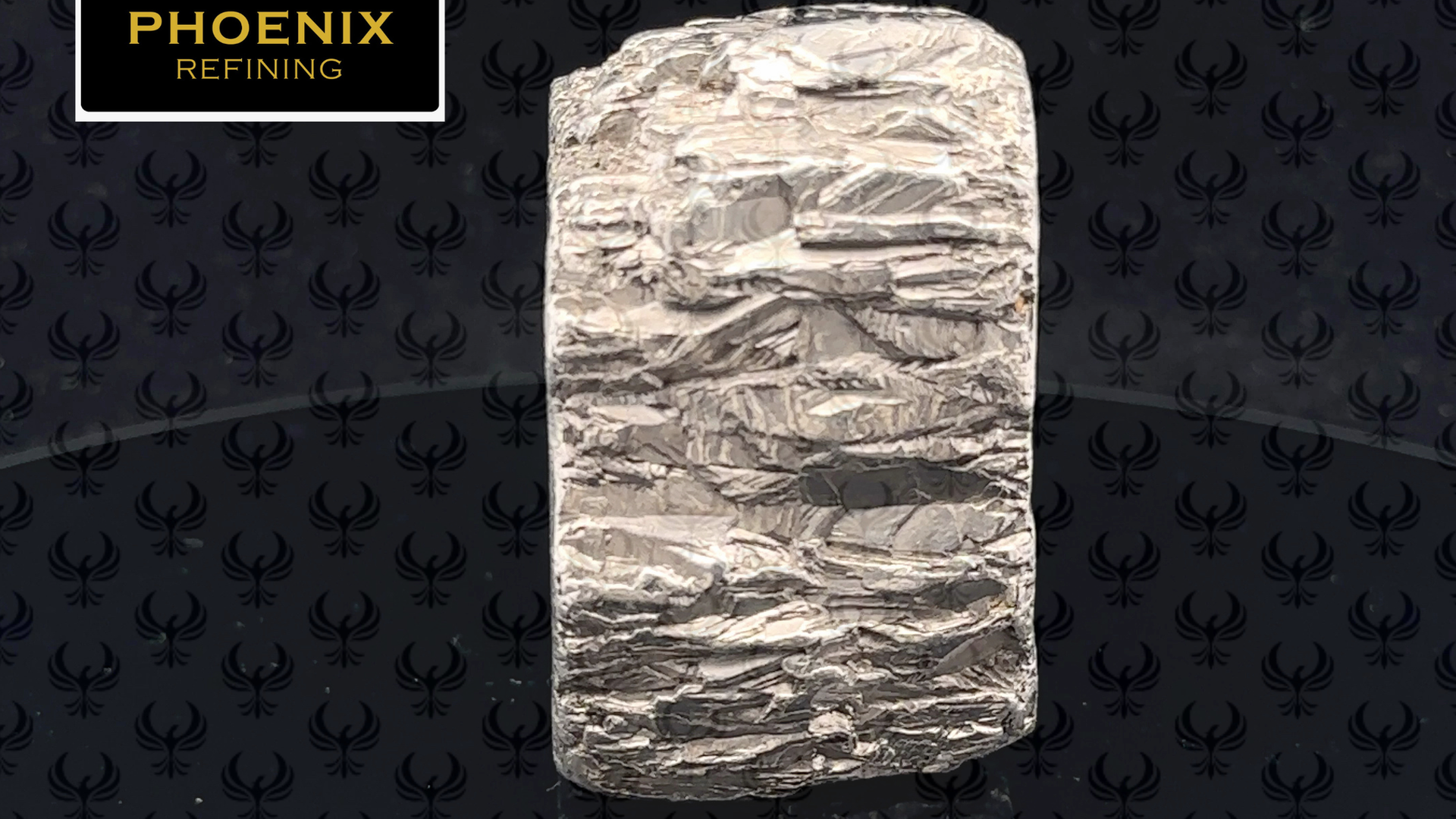
High-purity single crystals are essential for advanced technologies, including lasers, LEDs, telecommunications devices, optical components, scintillation detectors, and high-power semiconductors. Researchers typically grow crystals such as sapphire, yttrium aluminum garnet (YAG), lithium tantalate, calcium tungstate, yttrium aluminum perovskite (YAP), and beta-gallium oxide using high-temperature techniques, including Czochralski (CZ), Edge-defined Film-fed Growth (EFG), and Bridgman-Stockbarger growth. These techniques require a crucible that can contain highly reactive molten oxides and fluorides at temperatures often between 1,800°C and 2,200°C. Iridium has become the material of choice, and often the only feasible option, for crucibles because it has an exceptional melting point, chemical nobility, strength, and high-temperature stability.
Iridium melts at about 2,446°C and has a density of 22.39 g/cm³; its Young's modulus of about 528 GPa gives it exceptional stiffness, allowing the crucible to withstand deformation from dense molten materials. It also has relatively low thermal expansion and favorable electrical properties for induction heating. In many crystal-growth furnaces, a high-frequency induction system heats the iridium crucible directly, allowing precise control of the thermal gradient at the melt-crystal interface. This control is essential because crystal quality depends on stable melt flow, accurate temperature distribution, controlled solidification, and a contamination-free environment. If the crucible becomes damaged, distorted, or chemically degraded, it can cause crystal defects, reduce yield, and risk furnace failure.
Iridium also breaks down over time with use. Individual crystal growth programs can last hundreds or even thousands of hours under severe thermal and mechanical stress. The crucible wall must withstand hydrostatic pressure from the molten material, rapid temperature changes, electromagnetic heating, and direct contact with aggressive molten compounds. A major failure mechanism is high-temperature creep. At high temperatures, iridium gradually deforms under a constant mechanical load. After many crystal-growth cycles, this deformation can cause warping, loss of roundness, distortion at the bottom, and changes in wall shape. Such changes can affect melt flow and thermal gradients, thereby influencing crystal quality. Grain growth and recrystallization also occur during prolonged high-temperature operation. The fine grains in a newly manufactured crucible can coarsen considerably after repeated exposure to temperatures above 1,900°C. Because larger grains reduce fracture resistance, the crucible becomes more prone to cracking during heating and cooling. Grain-boundary grooving, thermal etching, and microcracks can further weaken the structure.
Oxidation must also be carefully controlled. Although iridium is more oxidation-resistant than many refractory metals, high oxygen activity at elevated temperatures can form volatile iridium oxides and gradually deplete the metal. That is why researchers typically use inert gases such as argon, helium, or nitrogen, or carefully balanced low-oxygen atmospheres. For instance, in gallium oxide growth, the furnace atmosphere must supply enough oxygen to stabilize the melt without excessively oxidizing the iridium. Iridium can also slowly dissolve into molten oxide systems. Although the dissolution rate may be low, prolonged exposure still reduces crucible wall thickness. When a crucible becomes thin, cracked, heavily contaminated, or dimensionally unstable, continuing to use it becomes risky. In such cases, failure may cause molten material to escape the crucible and seriously damage the furnace insulation, induction coils, and surrounding equipment.
Do not treat a retired iridium crucible as ordinary scrap; it remains a highly concentrated source of one of the rarest and most valuable platinum-group metals. Recycling matters because primary iridium production is limited, geographically concentrated, and environmentally intensive. Iridium is usually obtained as a by-product of platinum-group-metal mining, a process involving deep mining, crushing, flotation, smelting, and complex refining.
The crucibles are first cleaned, then mechanically treated. They remove residual oxides, fluxes, and contaminants from the furnace as thoroughly as possible. The crucible is then sectioned or milled to increase its surface area before chemical recovery. This preparation is necessary because iridium is extraordinarily corrosion-resistant and does not dissolve easily in ordinary acids. Refining techniques may include alkaline oxidative fusion, electrochemical dissolution, microwave-assisted leaching, or chloride-based chlorination systems. In alkaline fusion, iridium scrap reacts with strong oxidizing alkaline salts at high temperature, converting the metal into soluble iridate compounds. Electrochemical methods use concentrated hydrochloric acid and a controlled electric current to dissolve iridium into chloride complexes while minimizing unwanted contaminants. More modern microwave and closed-system chlorination processes improve speed, safety, and energy efficiency.
After dissolution, the iridium solution undergoes several purification stages. The process must remove base metals such as iron, copper, nickel, calcium, and zinc, as well as small amounts of platinum-group metals that may be in the scrap. The process then recovers iridium as a highly purified chemical salt, usually ammonium hexachloroiridate, and subsequently reduces it with hydrogen to yield metallic iridium powder. This powder can be melted, consolidated into ingots, rolled into sheets, shaped, welded, and annealed to produce new high-temperature components and crucibles. Because this is a closed-loop process, it returns valuable iridium to industrial use while reducing the need to mine raw iridium.
The environmental advantages of recycling iridium are considerable. CO₂-equivalent emissions from virgin iridium production are estimated at 12,000 to 42,000 kilograms per kilogram of metal, depending on the mining and refining method. Secondary recovery from high-grade industrial scrap can often reduce this impact by around 98%. Recycling also avoids much of the environmental impact of primary mining, including large-scale ore processing, sulfur dioxide emissions, energy-intensive smelting, mine waste, and tailings management. This benefit stems from the fact that used crystal-growth crucibles contain a concentrated amount of iridium and are therefore particularly valuable for recycling.
For both crystal growers and semiconductor device makers, recycling also strengthens supply chains. Instead of replacing each retired crucible with freshly mined iridium, companies can use a closed-loop recovery scheme to recover the metal value from used equipment. This reduces the financial impact of buying new material while supporting continued access to a strategic metal required to produce advanced crystals.
Phoenix Refining is currently buying used iridium crucibles and iridium-containing scrap from companies involved in single-crystal growth, the semiconductor industry, optical manufacturing, research, and high-temperature manufacturing. Even if the crucibles are warped, cracked, thinned, contaminated, or no longer suitable for crystal growth, they may still have considerable recoverable iridium value. The company buys crucibles used to produce sapphire, YAG, lithium tantalate, gallium oxide, fluoride crystals, and other high-temperature crystals. It also buys iridium sheets, electrodes, fabrication trimmings, failed components, and other iridium-containing materials.
Selling used iridium crucibles to Phoenix Refining lets companies recover capital from equipment no longer in use while promoting responsible precious-metal recycling. Instead of letting high-value iridium sit idle or end up in an uncertain scrap market, crystal producers can return it to a controlled circular supply chain. If your company has used iridium crucibles or iridium-containing production scrap, Phoenix Refining would like to buy the material and give it an evaluation.