In the global race to secure critical materials, platinum and iridium have become two of the most strategically important metals in modern industry. These Platinum Group Metals (PGMs) are prized for their exceptional resistance to heat and corrosion, as well as for catalytic properties that make them indispensable in applications ranging from automotive components to advanced clean-energy systems. For decades, supply came primarily from deep-level mining operations concentrated in South Africa, with smaller contributions from Zimbabwe and Russia. But rising extraction costs, geopolitical uncertainty, and the extreme rarity of these metals are pushing the industry toward a new reality: recovering value from waste.
Among these metals, iridium is especially scarce. It occurs in the Earth’s crust at an estimated concentration of only 0.000003 parts per million, and annual global production remains remarkably limited, roughly 5.5 to 7.7 metric tons per year. More than 85% of that output originates from South Africa. At the same time, demand is rising rapidly. In addition to established uses in electronics and chemical catalysis, iridium is now critical to Proton Exchange Membrane (PEM) electrolyzers, which rely on iridium-based anodes to withstand the acidic, oxidizing conditions of green hydrogen production. This combination of inelastic supply and expanding demand has transformed iridium into one of the world’s most supply-constrained industrial metals.
That market pressure has changed the economics of recycling. Automotive catalytic converters have long been recognized as a rich source of PGMs, but increasingly, high-performance spark plugs are drawing attention as a secondary source of platinum and iridium. Although each plug contains only tiny amounts of precious metal, the sustained rise in iridium and platinum prices, combined with advances in automated dismantling and chemical recovery, has made spark plug recycling commercially viable. What was once discarded into ordinary steel scrap now represents a small but meaningful urban ore body.
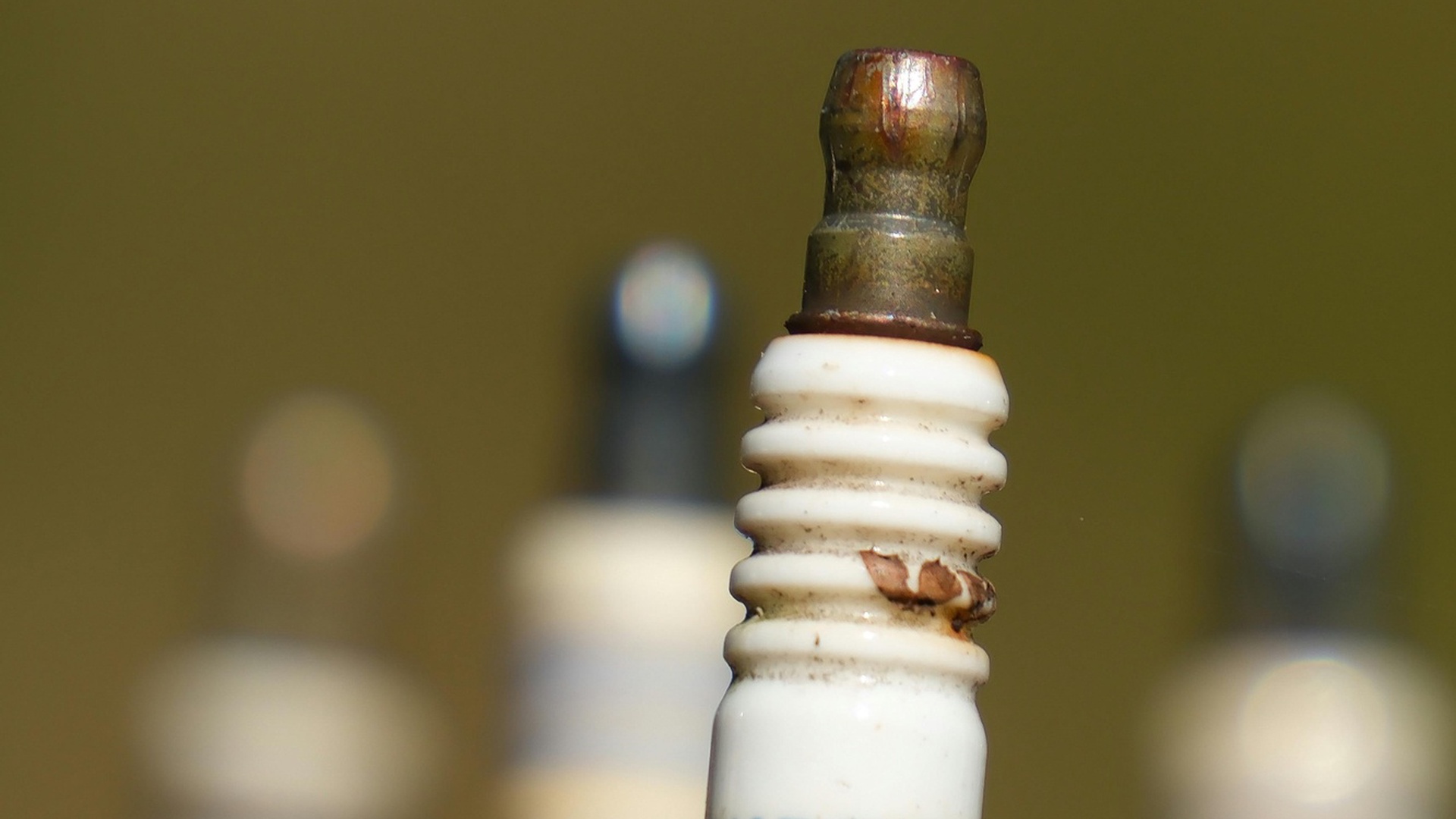
A spark plug is a compact yet sophisticated component designed to withstand one of the harshest environments in any machine: the combustion chamber of an internal combustion engine. It includes a steel shell, a ceramic insulator, a conductive core, and a pair of electrodes across which the ignition spark jumps.
The use of platinum and iridium is driven by engineering necessity. Spark plug designers aim to reduce the voltage required to create a spark while minimizing the electrodes’ tendency to absorb heat from the newly formed flame kernel, a phenomenon known as quenching. Finer electrodes improve ignition performance by concentrating the electric field and reducing heat loss. But ordinary metals such as nickel or copper cannot endure the intense thermal and chemical stress of combustion for long. Platinum, with a melting point of 1,772 °C, offers excellent durability and corrosion resistance. Iridium is even more robust, with a melting point of 2,446 °C and exceptional hardness. These properties allow manufacturers to produce ultra-fine electrodes that last for tens of thousands of miles.
Modern spark plug designs reflect this precision. DENSO, for example, manufactures plugs with a 0.4 mm iridium center electrode and, in some models, a platinum ground electrode around 0.7 mm in diameter. NGK’s Iridium IX plugs use a slightly thicker 0.6 mm iridium center electrode to balance performance and longevity. These dimensions improve spark efficiency and can contribute to better throttle response and lower hydrocarbon emissions. The iridium itself consists naturally of two stable isotopes, ^191Ir and ^193Ir. Based on iridium’s average atomic mass of 192.22 amu, the isotopic composition is approximately 39% ^191Ir and 61% ^193Ir. While this isotopic distribution has little effect on recycling value, it illustrates the chemical precision of the material involved.
The challenge in spark plug recycling is not whether precious metals are present, but how little is present in each unit. Electrode tips may be only 0.4 to 0.6 mm in diameter and 1 to 2 mm long. Their mass is measured in fractions of a milligram. In addition, these tips are often alloys rather than pure metals. Platinum ground electrodes may include palladium and iridium, while iridium center electrodes may contain rhodium or other alloying elements to improve oxidation resistance. This means recovery is a high-volume business. No single spark plug contains enough metal to justify individual processing. Profit depends on collecting and processing tens of thousands of units at a time.
What has made spark plug recycling newly attractive is price. Iridium has experienced one of the most dramatic commodity price increases of any industrial metal in recent years. By April 14, 2026, iridium was trading at about $278.17 per gram, far above platinum, palladium, or even gold on a per-gram basis. Platinum, while less explosive in price movement, also remained elevated at roughly $67.48 to $68.67 per gram in mid-April 2026.
At those values, even modest recovery becomes meaningful. A laboratory-scale batch yielding 0.18 grams of iridium and 0.27 grams of platinum can represent about $68 in raw metal value from material that would otherwise have gone into low-value scrap. Scale that across industrial volumes, and the economics become compelling.
Recycling spark plugs for platinum and iridium is a vivid example of how waste streams can become strategic resources. The individual metal loadings are tiny, the chemistry is demanding, and the safety requirements are substantial. But market forces have changed. As iridium and platinum remain scarce and valuable, and as green hydrogen technologies place new pressure on global supply, secondary recovery is no longer optional at the margins. It is becoming part of the core supply chain.
The future of spark plug recycling will depend on three things: reliable high-volume sourcing, efficient automated dismantling, and disciplined chemical refining carried out under strict safety and environmental controls. In places like the Philippines, success will also depend on integrating with local scrap networks and meeting rigorous regulatory standards.
What was once just dirty automotive waste is now a source of some of the world’s most critical metals. In an era defined by material scarcity and energy transition, the humble spark plug has become an unlikely but important contributor to the circular economy.