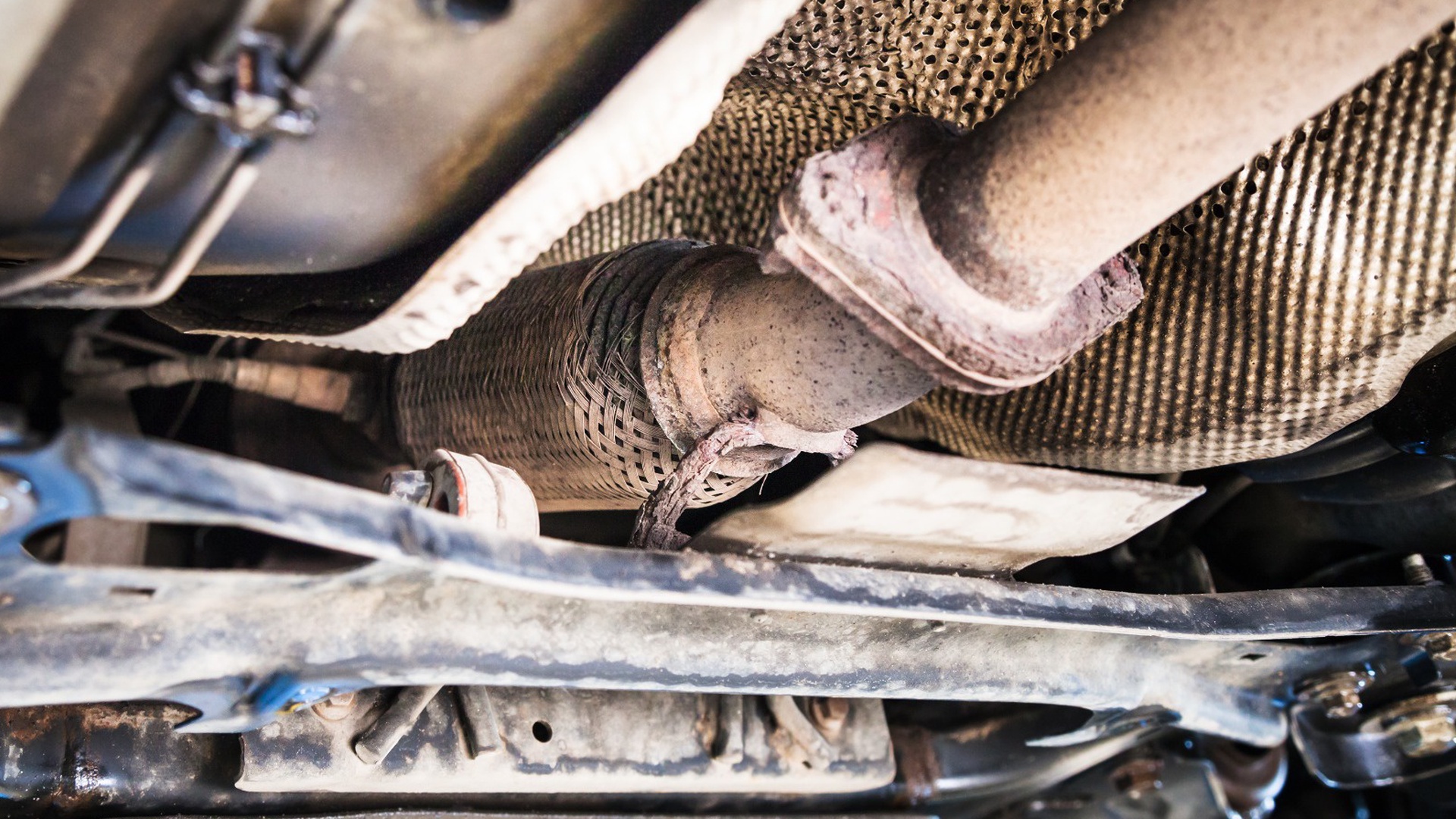
A cat is easy to miss. It's a steel housing under the car that contains a ceramic honeycomb coated with a tiny amount of precious metal. At rhodium's 2021 price peak, a cat with just 1 gram of rhodium was worth nearly $1,000 at the quoted metal price. That's one reason an ordinary exhaust item can become such valuable scrap. Rhodium typically makes up only a small share of a cat's total precious metal weight. Its value comes down to two things: it does a very difficult job of cleaning the exhaust, and its price can skyrocket when supply is constrained.
Gasoline engines produce NOx (nitrogen oxides), which are smog-forming and respiratory problem-forming pollutants. In the 3-way catalytic converter, Pt and Pd handle CO and unburnt hydrocarbons (converting them into CO₂ and water). Rhodium handles the other part of the equation, converting NOx into nitrogen, the gas that makes up most of the air we breathe. The reaction takes place on the rhodium surface. NO molecules adsorb onto the rhodium, weakening the bond between the N and O atoms. The N atoms can then combine to form N₂. Rhodium does this across the varying temperatures and air/fuel ratios you'll encounter in normal driving.
Manufacturers disperse rhodium as fine particles over a porous coating on the ceramic honeycomb (to maximize the amount of rhodium exposed to the exhaust). Other materials store and release oxygen as engine conditions vary. The design is critical because extreme heat can cause the rhodium particles to clump, and oil contaminants from the engine can coat the rhodium's active surfaces. Even with attempts to use less rhodium or find a replacement, it remains a fundamental part of the commercial gasoline converter.
Rhodium's price history is among the most volatile of precious metals. It was well over $10k an ounce in 2008, and then it plummeted during the financial crisis. It was in the $ 2k–$2.5k range around 2018. Stricter vehicle emissions requirements drove up demand, while pandemic-era mining disruptions kept supply down. It hit $30k an ounce in March 2021.
The spike didn't last. By 2024, rhodium was down to around $4,800 an ounce. For anyone looking at a used converter, that's a massive difference in value, as the same amount of metal could be worth many times more or many times less depending on when you sell it. Supply can't respond to higher prices quickly. Rhodium is generally a minor byproduct of mining platinum and other metals, and much of the world's primary production comes from South Africa. You can't just ramp up rhodium production in a mine without also ramping up the production of the other metals in the ore, and new mine capacity takes years to come online. In a relatively small market, a sudden shortage can therefore have a huge impact on prices.
A gas converter may contain as little as 1 or 2 g of rhodium (the amount varies enormously from car to car and with emissions specs). Platinum and palladium can make up a larger share of the precious metal content. Still, during a spike in rhodium prices, it will be the biggest contributor to the converter's value. The buyer has to account for the cost of finding, recovering, and refining it. You can't reliably tell what's in a converter just by looking at it. The buyer may start with a stamped part number, but with large lots they'll sample and test to establish the actual metal content. Vehicle type is also a factor. Gas and hybrid converters will use rhodium for NOx control. Diesels will generally use a different NOx control technology and will have very little or no rhodium in their oxidation catalysts. Two converters that look absolutely identical externally can therefore have very different values.
In 2021, rhodium prices made converters a very attractive target for thieves, and vehicle owners found themselves with repair bills that could be many times what the thief would have got for the part. On the other hand, legitimate recycling remains an important source of supply. Rhodium recovered from old converters can be re-refined and put back into new ones. A gram or two of rhodium will meet a vehicle's emissions requirements, and that small amount is hard to source and slow to come through, which is why it can be worth hundreds of dollars in scrap. If you have any converters to get rid of, Phoenix Refining will take them and help you move them to the next stage for value.