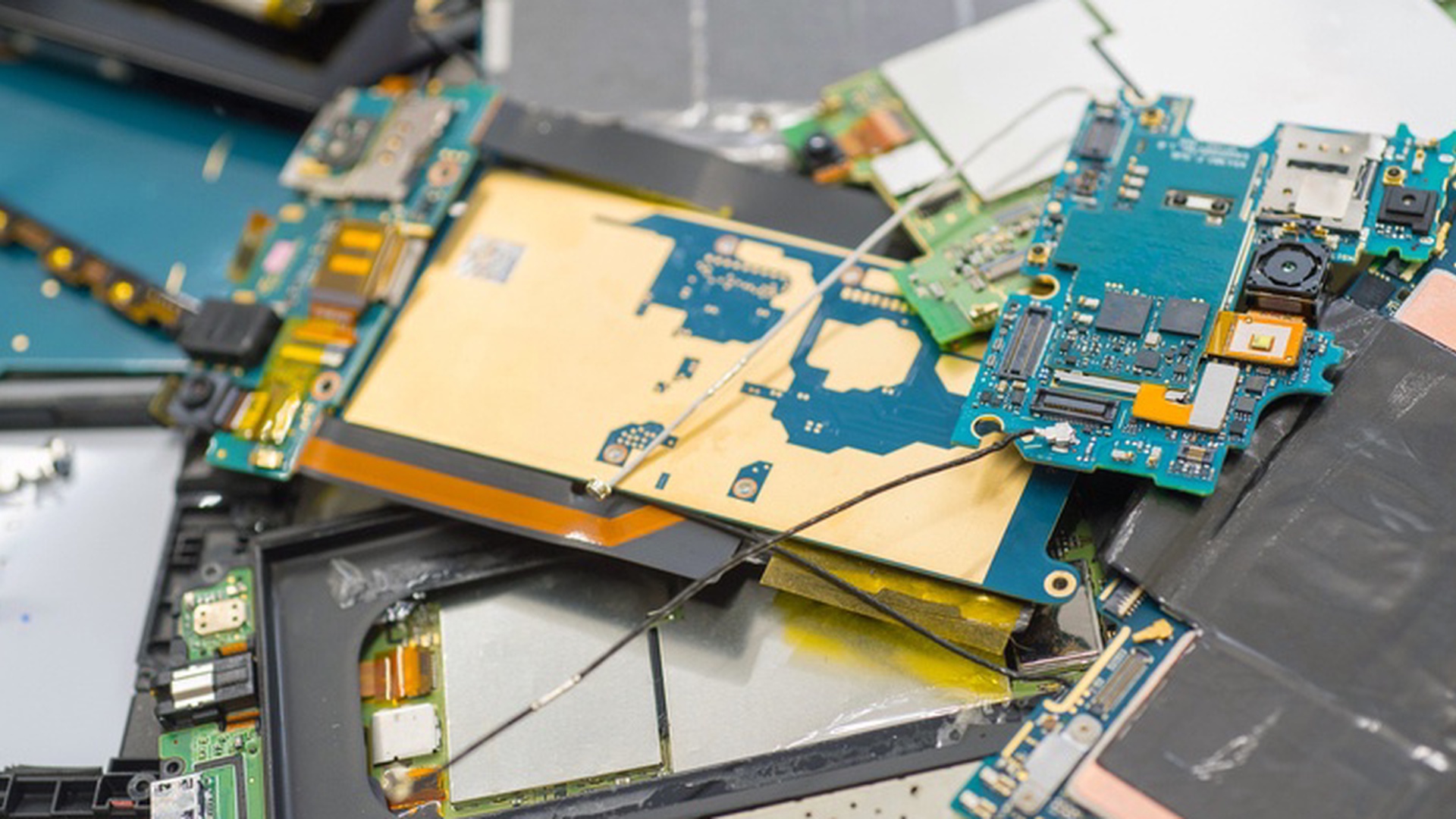
The unprecedented acceleration of artificial intelligence, machine learning, and hyperscale cloud computing has triggered a structural transformation in global data center architecture and, with it, one of the most lucrative recycling opportunities of the decade. As facilities scale to meet exabyte-level storage demands, operators are aggressively retiring legacy hardware, replacing Perpendicular Magnetic Recording (PMR) hard drives that top out at 16 to 20 terabytes with next-generation Heat-Assisted Magnetic Recording (HAMR) and Microwave-Assisted Magnetic Recording (MAMR) drives capable of 30 to 36 terabytes and beyond. This mass decommissioning is releasing billions of terabytes of legacy storage into the IT Asset Disposition (ITAD) stream. Hidden inside every one of those retired PMR drives is a nanometer-thick layer of ruthenium, one of the rarest platinum group metals (PGMs) on Earth and one whose price has surged to near-record highs. While e-waste recycling has historically centered on recovering gold, silver, and palladium from circuit boards, a convergence of supply bottlenecks and explosive new demand has fundamentally redrawn ruthenium's macroeconomic profile, transforming the humble hard drive platter into a strategic above-ground reserve.
Ruthenium is among the rarest stable elements in the Earth's crust. Prized for its extreme hardness, 2250°C melting point, and exceptional electrocatalytic properties, it has evolved from niche industrial input into an asset indispensable to advanced computing and the global energy transition. The problem is supply. There are no dedicated ruthenium mines anywhere in the world. The metal is extracted entirely as a byproduct of platinum and palladium mining, with South Africa's Bushveld Igneous Complex accounting for more than 90% of global output, the remainder coming from Russia, Zimbabwe, and minor North American deposits. Because production is captive to platinum-market economics, supply cannot scale in response to ruthenium-specific demand spikes.
And the South African PGM sector is in structural decline. The World Platinum Investment Council confirmed a 1.082 million-ounce platinum deficit in 2025, the deepest in a decade, leaving above-ground inventory covering only about four months of demand. Primary platinum output has fallen from roughly 5.3 million ounces in 2006 to 3.9 million ounces in 2025, despite strong prices. The culprits are chronic: Eskom's protracted electricity crisis has driven power costs up roughly 60% between 2021 and 2026, while persistent load-shedding has forced deep-level, energy-intensive mines to throttle production. Geopolitical exposure compounds the risk, as about 60% of South Africa's diesel imports, critical for backup generation and mining fleets, transit the Strait of Hormuz. New projects like Ivanhoe's Platreef mine offer eventual relief, but with 5- to 10-year lead times from assessment to first metal, the supply gap will widen before it narrows.
Against this fragile supply picture, demand is accelerating. The global ruthenium market, valued at $0.74 billion in 2025, is projected to reach $1.42 billion by 2034, a 7.5% compound annual growth rate.
Semiconductors are the most transformative driver. As chips shrink to 7-nanometer nodes and below, traditional interconnect materials such as tungsten and cobalt exhibit unacceptable increases in resistivity and electromigration failures. Ruthenium's extremely low resistivity at ultra-narrow line widths, plus compatibility with atomic layer deposition and chemical vapor deposition, has made it the premier replacement. TSMC, Samsung, SK Hynix, and Intel have all qualified ruthenium metallization for advanced architectures. Intel deploys it as the liner in its 18A RibbonFET gate-all-around transistors, while Samsung uses ruthenium electrodes in DRAM capacitors. With semiconductor capital expenditure on advanced-node equipment exceeding $190 billion in 2024 and ruthenium intensity rising with each node transition, this sector alone is expected to contribute roughly 35% of demand growth through 2034.
Green hydrogen represents a demand category that barely existed five years ago. Ruthenium oxide is the most active catalyst for the oxygen evolution reaction in proton exchange membrane (PEM) electrolyzers. Iridium has traditionally dominated the application, but its extreme scarcity has pushed manufacturers such as Nel Hydrogen, ITM Power, Plug Power, and Siemens Energy toward ruthenium-iridium mixed oxides that reduce precious-metal loading per megawatt. With announced green hydrogen capacity exceeding 320 gigawatts by early 2026, conservative scenarios put hydrogen-sector ruthenium demand at 4 to 7 metric tons annually by 2030.
Chemical catalysis rounds out the picture: ruthenium remains essential in dimensionally stable anodes for chlorine production (a mixed-metal-oxide anode market projected to hit $2.05 billion by 2033), acetic acid manufacturing, and ammonia synthesis, where ruthenium-promoted catalysts, attracting renewed interest from firms like BASF, enable operation at pressures 50% below conventional iron catalysts.
The result: after years slumbering around $70 per troy ounce, ruthenium surged to $800 in 2025–2026, matching the historic peak set during the original PMR rollout in 2007 and ranking among the strongest-performing commodities of the decade.
The story of ruthenium in storage begins with a physics crisis. In the early 2000s, the industry hit the superparamagnetic limit: as magnetic grains shrank to boost areal density, ambient thermal energy became sufficient to spontaneously flip their magnetic orientations, corrupting data and halting density scaling. IBM's answer was Anti-Ferromagnetically Coupled (AFC) media, famously dubbed "Pixie Dust." The breakthrough involved depositing an ultra-thin ruthenium layer, precisely three atoms thick (0.4–0.9 nanometers), between two ferromagnetic layers. The quantum-mechanical properties of this spacer lock the layers' magnetic orientations in opposite directions, thereby artificially increasing the effective magnetic volume of each bit without enlarging its footprint. Capacities quadrupled almost overnight.
The concept was integrated into perpendicular magnetic recording, which shipped commercially in 2005. PMR platters are marvels of nanoscale engineering: an aluminum-magnesium alloy or glass substrate coated with a nickel-phosphorus smoothing layer, followed by ruthenium serving double duty as the AFC coupling layer and as an epitaxial underlayer establishing the hexagonal close-packed crystal orientation needed for the cobalt-platinum-chromium recording layer to grow in isolated, 7–8 nanometer columnar grains. A diamond-like carbon overcoat protects the media from read/write heads flying 3–5 nanometers above the surface at speeds up to 15,000 RPM. The ruthenium in a single platter is measured in micrograms, but the aggregate is staggering. Modern enterprise drives pack up to 12 platters into helium-sealed enclosures, and global HDD production has historically reached hundreds of millions of units annually. At the height of the PMR transition between 2006 and 2008, the HDD industry consumed over 930,000 ounces of ruthenium in a single year, exceeding total global mined production, draining above-ground stockpiles, and driving the price to $800.
PMR has now hit its own ceiling at roughly 1.4 terabits per square inch. HAMR breaks through using iron-platinum (FePt) alloys whose extreme magnetocrystalline anisotropy makes them stable at nanometer grain sizes but so resistant to flipping that conventional heads cannot write to them. The solution is a plasmonic near-field transducer laser built into the head itself, momentarily heating each bit to its Curie temperature (400–500°C) to lower coercivity just long enough to record data before it cools and locks into place. The alternative, Flux Control MAMR, uses a spin-torque oscillator to induce ferromagnetic resonance rather than heat.
For operators, the payoff is compelling: 30TB in the same 3.5-inch footprint as a legacy 16TB drive, cutting power consumption per terabyte by nearly 40%, vital for AI facilities straining against grid constraints. As hyperscalers dump their 8 TB-16 TB PMR fleets, an unprecedented volume of ruthenium-rich platters is flooding the secondary market.
The ITAD sector, valued at $11-$17.5 billion in 2025, is projected to exceed $40.1 billion by 2035. Growth is propelled by cloud adoption, edge data centers, 3- to 5-year refresh cycles, privacy regulations such as GDPR and HIPAA, and escalating ESG mandates. Large enterprises account for 66.9% of revenue; North America leads with a 41% share while Asia-Pacific grows fastest at 13.3% annually. But the industry faces a fundamental conflict. Driven by breach anxiety and regulatory risk, an estimated 90% of data center hard drives are physically shredded at the end of life. Shredding guarantees data destruction and renders data worthless. The aluminum chassis, neodymium-iron-boron voice-coil magnets, copper coils, and precious-metal-bearing circuit boards become a contaminated, heterogeneous mass. Extracting nanometer-thick ruthenium layers from that slurry is exponentially harder than processing intact platters.
The solution is the IEEE 2883-2022 standard, which supersedes legacy NIST 800-88 practices ill-suited to modern drives with hidden partitions, over-provisioned sectors, and complex firmware. IEEE 2883-2022 defines rigorous sanitization to a drive's native physical capacity, including cryptographic erase, which irreversibly destroys onboard encryption keys and explicitly validates logical sanitization as a forensically sound alternative to shredding. With this auditability, operators can authorize non-destructive dismantling: automated systems can now extract rare-earth voice-coil magnets in 6 seconds per drive, and pristine ruthenium-coated platters can be harvested cleanly for hydrometallurgical refining.
The forces reshaping the ruthenium market are structural, not cyclical. Primary supply is trapped in a declining South African mining sector with no ability to scale, while demand from advanced semiconductors and green hydrogen accelerates relentlessly. Into this gap flows an unprecedented resource: billions of PMR hard drives being retired by the AI-driven shift to HAMR storage, each containing recoverable ruthenium now trading at $800 per ounce.
Capitalizing on this opportunity demands one decisive change: abandoning the shredder. The IEEE 2883-2022 standard demonstrates that cryptographic sanitization delivers verifiable data security while preserving intact platters for efficient recovery, unlocking commodity revenue, resale value, and tradable carbon insets that cut Scope 3 emissions by up to 97% compared with mined metal.
The irony is fitting. The hard drive industry drove ruthenium to record prices in 2007; today, those same retired drives can return that metal to a market that needs it more than ever. The legacy PMR drive is no longer e-waste; it is one of the world's most concentrated and strategically vital above-ground reserves of ruthenium.