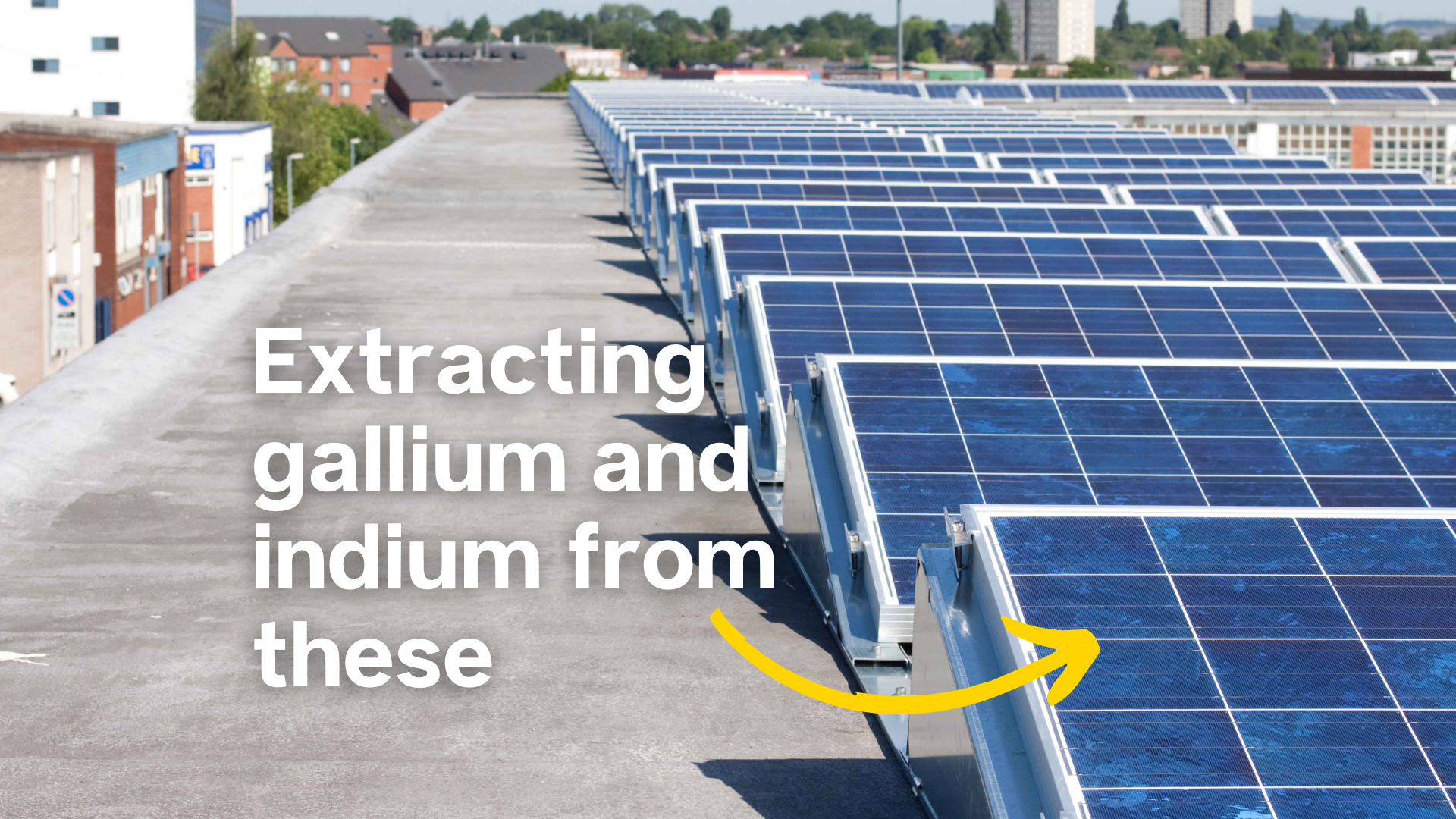
The recovery of gallium and indium from electronic waste (e-waste) is a growing concern due to the increasing global demand for these metals, their critical importance in high-tech applications, and the environmental impact of e-waste. Both gallium and indium are essential for various advanced technologies, including semiconductors, LEDs, solar panels, and flat-panel displays.
These metals are often found in small amounts within complex e-waste materials, such as GaAs (gallium arsenide), GaN (gallium nitride), and ITO (indium tin oxide), making their extraction and separation a challenging task. Despite these challenges, recovering gallium and indium from e-waste is considered a sustainable and strategic alternative to primary mining, particularly as these metals are rare and difficult to isolate from natural ores.
Gallium and indium are primarily byproducts of other metal refining processes. Gallium is mostly obtained from bauxite and zinc sulfide ores, while indium is extracted from zinc sulfides, with smaller quantities coming from other ores like copper, iron, tin, and lead. The increasing demand for these metals, particularly in the electronics industry for applications such as LEDs, semiconductors, and flat-panel displays, has raised concerns about resource depletion and the environmental impact of extracting them from primary sources.
E-waste, which includes discarded electronics such as smartphones, computers, and televisions, is a valuable source of gallium and indium. As electronic devices often contain small but significant amounts of these metals, recycling e-waste for metal recovery is considered both economically viable and environmentally essential.
The recovery of gallium and indium from e-waste requires specialized methods due to the complex forms in which these metals are present. Various techniques, including physical separation methods, leaching, solvent extraction, sorption, and precipitation, are employed to separate and recover these metals.
The initial step in the recovery of gallium and indium typically involves physical separation methods, such as grinding, magnetic separation, and electrostatic separation. These methods are used to reduce the size of e-waste and to separate components based on their physical properties. Grinding and milling are commonly employed to break down e-waste into smaller particles, increasing the surface area for subsequent processing. High-energy ball milling (HEBM), for instance, can reduce particles to sizes as small as 1 μm within minutes, making it an effective technique for preparing materials for further recovery processes.
Once the e-waste is ground into smaller particles, physical separation techniques like magnetic and electrostatic separation are used to isolate the target metals. Magnetic separation is effective for extracting ferrous metals, while electrostatic separation targets non-ferrous metals based on differences in electrical conductivity. These methods are useful in the early stages of metal recovery, helping to separate the metals of interest from other materials before moving on to more specialized techniques.
Leaching is a critical hydrometallurgical process for extracting gallium and indium from e-waste. The process involves using an acid or other solvent to dissolve the metals from the solid waste, allowing them to be separated from other components. The choice of leaching method depends on the form in which gallium and indium are present in the e-waste.
For gallium, the most effective leaching agent is nitric acid, particularly when extracting gallium from GaAs (gallium arsenide). Nitric acid has been shown to achieve leaching efficiencies of up to 99%, making it the preferred choice. In contrast, gallium extraction from GaN (gallium nitride) requires more aggressive conditions, such as high pressure and temperature, typically around 200°C and 15 atm. Alternatively, alkaline salt roasting can be used to enhance the leaching efficiency of GaN materials.
Indium, on the other hand, is commonly leached from ITO (indium tin oxide) using various acids. Among these, sulfuric acid is the most commonly used due to its lower cost and reduced risk to equipment, while hydrochloric acid is also favored for its ability to prevent the generation of problematic waste. In some cases, nitric acid can also be used, though its high cost often makes it less attractive.
Solvent extraction is another widely used method for separating gallium and indium from the leachates. This process involves using organic solvents that selectively bind to the target metals, thereby separating them from other metals and impurities. The choice of solvent is critical, as it must have a high affinity for gallium and indium while having minimal affinity for other metals such as copper, zinc, or iron.
While solvent extraction is efficient, it has some disadvantages, including gradual solvent loss over time. This not only increases the cost of the process by requiring solvent replenishment but also poses environmental risks, as some solvents can be toxic. Additionally, the extraction process can be time-consuming, requiring appropriate contact times between the solvent and the leachate, followed by separation of the extractant from the raffinate using a centrifuge or other means. Despite these challenges, solvent extraction remains one of the most popular methods for separating and purifying gallium and indium.
Sorption methods have emerged as an alternative to solvent extraction, offering several advantages, including reduced solvent loss and a more environmentally friendly process. Sorption involves the use of solid or liquid materials that selectively adsorb gallium and indium from solution. Various sorbents, including synthetic resins, silica gels, and biological materials such as microorganisms, can be used to capture gallium and indium selectively.
One key benefit of sorption methods is that they do not have the same issues as solvent extraction, such as gradual extractant loss. Sorption processes are generally faster and do not require the long contact times required by solvent extraction. Additionally, they can effectively work with low metal concentrations, making them suitable for handling e-waste with relatively low gallium or indium content. However, the choice of sorbent depends on the specific composition of the e-waste and the acid used in the leaching stage. Recent advances in the use of living organisms or their fragments as sorbents have shown promise, offering high selectivity for gallium and indium while reducing the environmental impact of the process.
Precipitation is primarily used for the recovery of indium, particularly from ITO, as it can result in high-purity indium. In this method, specific reagents are added to the solution to induce the precipitation of indium, which can then be filtered out and separated. This method is relatively simple and can produce indium with purity levels of up to 99.99%. However, for higher-purity indium, additional steps, such as solvent extraction, may be necessary to refine the metal further.
For gallium recovery, ionic liquids such as tribromide are increasingly being explored for the selective extraction of gallium, indium, and other elements, such as arsenic, from GaAs and GaN waste. These ionic liquids can achieve high recovery efficiencies (over 95%) and offer the additional benefit of isolating arsenic in a less toxic form, H₂AsO₄, compared to other recovery methods. However, challenges remain in isolating gallium from GaN waste, and further research is needed to optimize this technique for industrial-scale applications.
Despite the variety of methods available for the recovery and separation of gallium and indium, several challenges persist. E-waste is highly diverse, and the presence of other metals and compounds can complicate the separation process. In particular, gallium and indium are often bound within complex alloys or compounds, making them difficult to extract efficiently. Furthermore, many available recovery techniques, such as solvent extraction, suffer from issues including solvent loss, high operational costs, and potential environmental hazards due to the toxicity of certain solvents.
Another challenge is the lack of a comprehensive, standardized recycling system for e-waste in many regions, particularly in the European Union. While some e-waste streams, such as LCDs, are well collected, there is no fully established system for recovering indium or gallium from electronic devices at the end of life. Research into more efficient, cost-effective, and environmentally friendly recovery methods is essential to overcoming these barriers.
The separation and recovery of gallium and indium from e-waste are complex and multifaceted processes that require a combination of physical, chemical, and biological methods. Techniques such as grinding, leaching, solvent extraction, sorption, and precipitation show promise for recovering these valuable metals, though each method has its advantages and limitations.
Ongoing research into combining these methods, as well as the development of new techniques such as solvent-impregnated resins or ionic liquid-based recovery, will be essential to improving the efficiency and sustainability of gallium and indium recovery from e-waste.
Overcoming the technical and economic challenges involved in these processes, along with improvements in e-waste management and recycling infrastructure, will help ensure that gallium and indium can be recovered more effectively, reducing reliance on primary mining and mitigating the environmental impact of electronic waste.