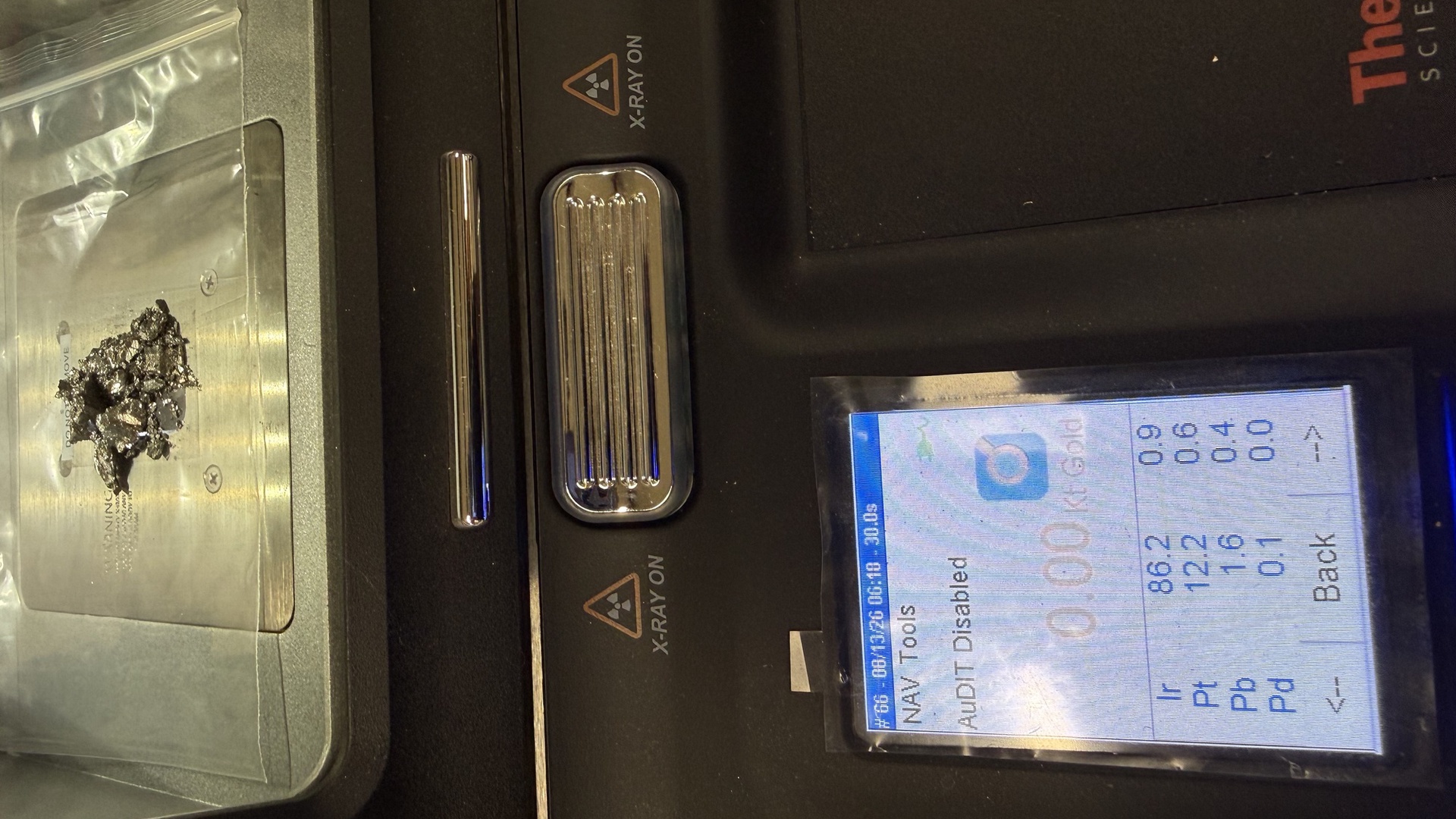
A single spent crucible pulled from a sapphire crystal-growth furnace can contain enough solid iridium to recover value that exceeds the entire cost of insured cross-country freight. Meanwhile, the smartphone in your pocket contains only a few micrograms of the same metal, locked inside the phosphorescent emitters of its OLED screen. Between these two extremes lies one of the most urgent resource problems of the decade: at spot prices approaching $287,000 per kilogram in 2026, iridium is now too valuable to discard in any form, yet it remains one of the hardest elements on Earth to recover.
The numbers explain why. Global mine production of iridium totals just 7.1 to 7.5 tonnes per year, a supply that cannot be expanded in response to demand because iridium is extracted almost exclusively as a minor byproduct of platinum and palladium mining, with South Africa's Bushveld Complex alone accounting for roughly 84–85% of world output. Producers cannot ramp up iridium without flooding markets with carrier metals, making primary supply structurally inelastic. Against this fixed ceiling, demand is compounding: proton exchange membrane (PEM) electrolyzers for green hydrogen require iridium oxide as a non-substitutable anode catalyst, and high-resolution displays depend on iridium(III) complexes for near-unity emission efficiency. The market now faces a projected deficit of 0.4 tonnes against demand of 7.5 tonnes in 2026. The gap will not be closed by mining. Whether the industry recovers enough from end-of-life devices will determine whether the gap closes. The obstacle is the metal itself. Iridium's density (22.56 g/cm³), melting point near 2,450°C, and status as the most corrosion-resistant metal in the periodic table—insoluble even in boiling aqua regia—make it indispensable in service and nearly indestructible in the scrapyard. Unlocking its value requires some of the most aggressive chemistry in modern refining.
The global iridium market, valued at $3.8 billion in 2025, is projected to reach $6.7 billion by 2034 (6.5% CAGR). Iridium metal commands 42.3% of the market, compounds such as IrCl₃ and IrO₂ hold 34.5%, and alloys account for 23.2%. Because iridium trades through over-the-counter bilateral agreements rather than on futures exchanges, with benchmarks published by Johnson Matthey, the LPPM, and Heraeus, pricing is highly sensitive to disruptions and speculation.
The past decade illustrates this volatility vividly. Prices held near $35,000–$54,000 per kilogram through 2019, but forecasts that 850 GW of electrolyzer capacity by 2030 could require 300–700 kg of iridium per GW, potentially consuming 30% of annual production, ignited a speculative surge, driving prices to nearly $200,000/kg in 2021. After a correction, concurrent demand from datacenters, OLED manufacturing, and renewed PEM installations pushed 2026 averages to roughly $269,000/kg. At these valuations, recovering iridium from even highly dispersed e-waste streams once dismissed as uneconomic has become fundamentally viable, fueling a precious-metals e-waste recovery market projected to grow from $11.13 billion in 2025 to $17.41 billion by 2032.
Cyclometalated iridium(III) complexes such as Ir(ppy)₃ are the gold standard of phosphorescent OLED emitters. First-generation fluorescent emitters were limited to about 25% internal quantum efficiency due to spin statistics. Still, the strong spin-orbit coupling of the heavy iridium nucleus allows for the harvesting of both singlet and triplet excitons, which raises the theoretical efficiency to 100%. Ligand engineering enables precise color tuning: fluorinated complexes emit deep blue light with external quantum efficiencies up to 29%, while dendrimer architectures reduce concentration quenching in solution-processed devices. Though each phone contains only sub-milligram quantities, the 62 million tonnes of e-waste generated globally in 2022 make aggregate recovery a genuine urban mining opportunity. Specialized refiners skip smelting and instead use mechanical disassembly of the display laminate, targeted solvent extraction with calibrated mixtures of dichloromethane, acetone, and cyclohexane, and either calcination to crude IrO₂ or solvent-extraction methods that achieve recovery yields above 80%.
PEM electrolyzers depend on iridium oxide as the only commercially viable catalyst for the oxygen evolution reaction in their brutally acidic, oxidative anodic environments. At 2.5–4 grams of iridium per kilowatt, scaling PEM capacity threatens to consume the entire global primary supply. Catalyst thrifting has cut loadings by up to 37%, but thrifting alone is mathematically insufficient; secondary recovery from spent stacks is the mandatory keystone of the hydrogen economy. The EU-funded BEST4Hy project showed the way forward: a high-pressure alcohol dissolution process that recovers ≥80% of intact PFSA ionomer and ≥90% of PGMs, and an ionic-liquid electroleaching route (BMIM Cl/BMIM TFSI) that dissolves and redeposits pure metal in a single vessel with no acids or toxic emissions. Crucially, MEAs remanufactured with 100% recycled catalysts matched beginning-of-life performance over 1,000+ hours, proving that a genuinely closed loop is achievable.
Spark plugs account for roughly 25% of iridium demand, with fine platinum-iridium firing tips extending service life beyond 120,000 km; recovery requires precise mechanical isolation of milligram-scale tips from steel and ceramic. Czochralski crucibles offer the opposite profile: massive, highly pure scrap with exceptional recovery economics. Dimensionally stable anodes from chlor-alkali plants and semiconductor sputtering targets round out a diverse stream of concentrated scrap.
Iridium's supreme corrosion resistance is precisely what makes recycling difficult, and refiners must forcibly disrupt its crystalline lattice. Traditional zinc alloying expands the lattice via a molten base-metal matrix that is then acid-leached away, leaving reactive "iridium black" powder. Alkali fusion with sodium peroxide at 600°C forms soluble ternary Na-Ir-O oxides that dissolve completely in hot hydrochloric acid as hexachloroiridate(IV). The state of the art, however, is plasma-chemical dissolution: applying 130–230 V DC at current densities of 80–120 A/dm² in concentrated HCl generates a plasma glow discharge on the metal surface that quickly shreds iridium directly into solution, is automatable, and produces no solid waste.
Regardless of the route, purification follows a common path: oxidation to [IrCl₆]²⁻, selective precipitation as ammonium hexachloroiridate, calcination to IrO₂, and hydrogen reduction at 300–400°C, yielding powder with over 99.95% purity, ready for use as catalysts, OLED precursors, or electron-beam consolidation into ingots.
True end-to-end iridium refining is confined to a powerful global oligopoly: Johnson Matthey in the UK, Heraeus Precious Metals in Germany, Umicore in Belgium, and Furuya Metal in Japan, because the advanced extraction technologies involved are capital-intensive and demand vast economies of scale. Yet e-waste containing trace iridium is generated everywhere, making regional collection and pre-processing infrastructure the decisive factor in how much metal actually survives the journey back to a refinery.
Singapore has emerged as the model for capital-intensive formalization in the Asia-Pacific region. SK Tes's $30 million facility, the first of its kind in Southeast Asia, processes up to 14 tonnes of batteries and e-waste daily, the equivalent of 280,000 smartphone batteries, achieving recovery rates above 90% at purities near 99%. The plant is partially powered by a 1 MWh second-life energy storage system fed by rooftop solar, embodying the circularity it enables. Complemented by specialized refiners such as BR Metals, which invested $4 million in 2025 to expand pre-treatment capacity, Singapore functions as a hyper-efficient regional funnel: drawing in end-of-life electronics from across ASEAN, extracting embedded iridium, gold, and palladium, and feeding high-purity concentrates directly to the global refining oligopoly. Where such formalized ecosystems are absent, trace PGMs embedded in complex devices are routinely lost to landfill, a leak in the global supply chain that only investment, technology transfer, and rigorous enforcement of transboundary movement controls, as under the Basel Convention, can seal.
Closing the iridium loop requires four systemic shifts: scaling up non-destructive extraction (hydrometallurgy, ionic liquids, and plasma chemistry) instead of brute-force smelting; commercializing selective solvent extraction to intercept micro-concentrated OLED waste; expanding formalized regional recovery hubs on the Singapore model to capture material before it leaks from the system; and embedding design-for-recyclability alongside continued catalyst thrifting.
For industrial holders of iridium-bearing scrap spent crucibles, sputtering targets, electrolyzer stacks, thermocouple wire, or catalyst residues, these market conditions have created an unprecedented window to monetize dormant assets. Established buyers such as Phoenix Refining are actively purchasing iridium materials across these categories, offering scrap holders a direct route into the formal recovery chain at a time when structural pricing strongly favors sellers. Iridium recovery is no longer a peripheral environmental initiative; it is a fundamental pillar of geoeconomic stability and the primary engine sustaining the hydrogen economy, advanced displays, and the extreme-environment technologies of the coming industrial era. Every kilogram returned to circulation through legitimate refining channels is a kilogram that never needs to be mined.