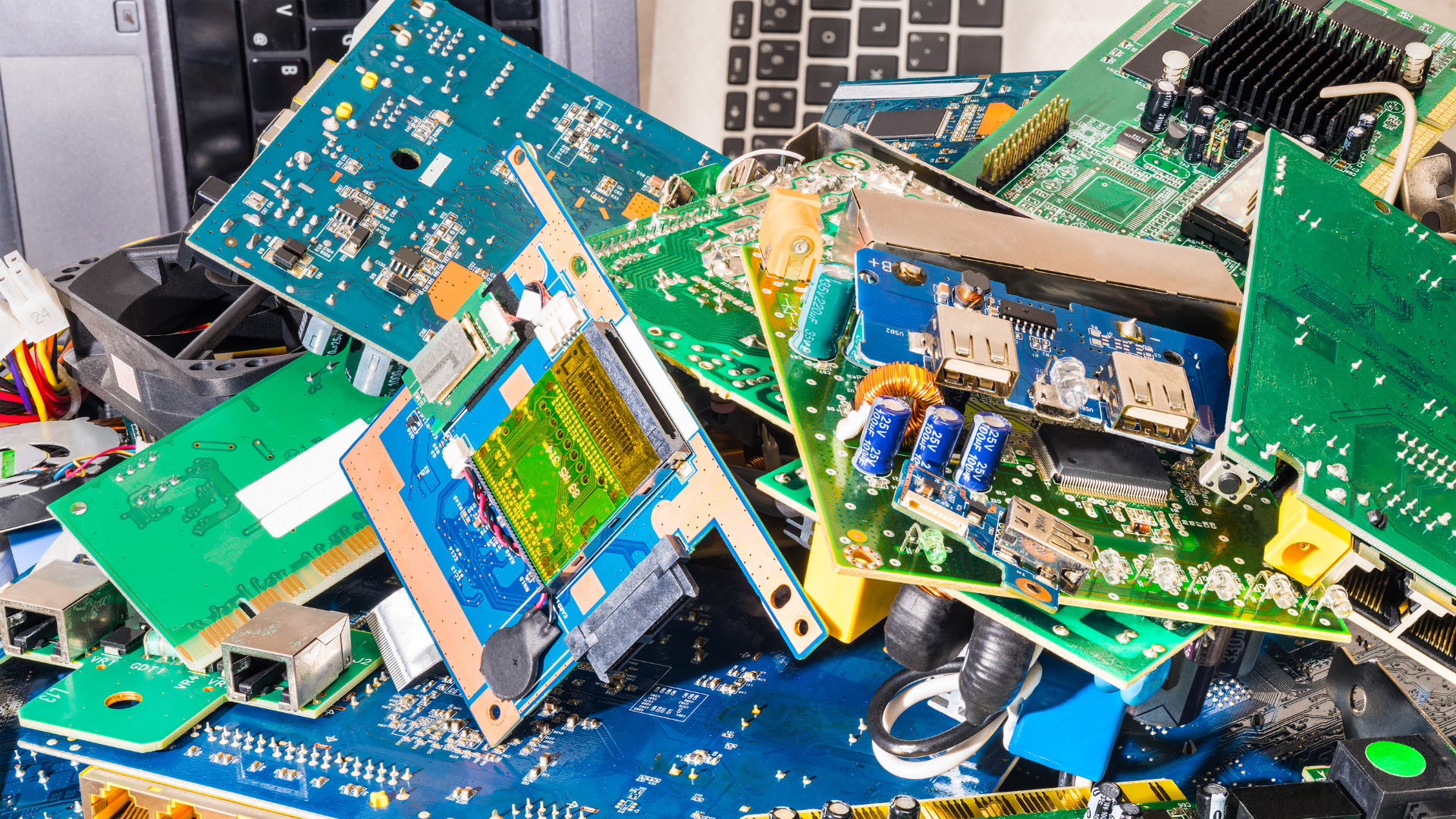
Urban mining, recovering metals from discarded products, is emerging as a strategic alternative to traditional mining. With global e-waste at 57.4 million metric tonnes in 2021 and rising by ~2 Mt per year, end-of-life electronics now form a stable, high-grade “urban ore.” Silver, essential to electronics and clean energy and trading above $50/oz, is a prime target for recovery.
Texas generates an estimated 531.4 million pounds of e-scrap annually but officially recycles only 35.1 million pounds. Over 500 million pounds (≈93%) of e-waste is either landfilled, mismanaged, or stockpiled. Existing recyclers report that their processing capacity exceeds collected supply, confirming that the bottleneck is collection, not technology. E-waste contains metals at concentrations far exceeding natural ore. One million cell phones can yield about 772 pounds (~350 kg) of silver, worth over $574,000 at current prices before factoring in gold, palladium, and copper.
Recovering metals from e-waste typically costs less than 8% of the cost of mining virgin ore. Lower material volume, less energy, and fewer environmental liabilities create a structural cost advantage and robust margins. The global precious-metals-from-e-waste market, valued at $6.76 billion in 2024, is projected to reach $10.61 billion by 2032 (5.8% CAGR).
Hydrometallurgy provides significant advantages over high-temperature smelting for treating complex, low-grade, heterogeneous e-waste. One of the key benefits is its lower energy consumption and reduced operating costs. Additionally, hydrometallurgy offers higher recovery rates across a broader range of metals, including valuable resources such as silver, copper, and essential battery metals. This method also results in lower air emissions and a smaller environmental footprint, making it a more sustainable option.
A particularly promising approach within this field is the two-step, non-cyanide thiourea process. The first step involves a pre-leach with sulfuric acid, which effectively removes base metals like iron and aluminum, achieving up to approximately 95% dissolution of iron. Following this, the thiourea leach process is employed to recover silver, with optimized conditions allowing for up to 100% recovery of this precious metal. This technique notably avoids the use of cyanide, which mitigates regulatory challenges and reduces liability risks, an important consideration for urban facilities.
For commercial sellers, understanding the technical refining process is essential for verifying settlement accuracy and ensuring that the maximum achievable yield is recovered from their material. The final payout is contingent not only on the current market price but also on the purity determination and the efficiency of the metallurgical extraction.
The initial and most critical step in refining is the assay, which determines the precise precious metal content of the received material. Payouts are consistently calculated based on the weight of the fine silver content, not the gross weight of the scrap.
The industry standard for definitive testing is the fire assay (or cupellation). This is the oldest, most reliable, and most trusted method for determining fine metal content, commonly used by precious metal refiners globally. The fire assay provides the highest accuracy, achieving 1–5 parts per ten-thousand. However, it is a destructive test and requires a processing time of 1–2 days for results. Reputable refiners conduct this test in triplicate to minimize variance and ensure results are highly accurate.
For rapid preliminary estimates or smaller, cleaner lots, XRF analysis offers a non-destructive alternative, yielding results in minutes with an accuracy of 2–5 parts per thousand. The disparity between some refiners' promise of 1–2 hour payment and the 1–2 business day T/A quoted by Dillon Gage often reflects the methodology chosen: the immediate liquidity model likely utilizes XRF or immediate spot valuation for standard sterling/karat scrap, while large, mixed, or high-value lots necessitate the more accurate, but slower, fire assay process.
To maximize financial returns on recovered silver and co-metals, your operation can partner with Phoenix Refining, a leading precious metals refiner. Phoenix Refining purchases and refines silver-bearing materials such as sterling silver, silver solutions (from hydrometallurgy), batteries, catalysts, and sweeps, providing high-purity outputs and fast payouts. This partnership allows your plant to focus on collection and primary recovery while relying on Phoenix for final refining and monetization.