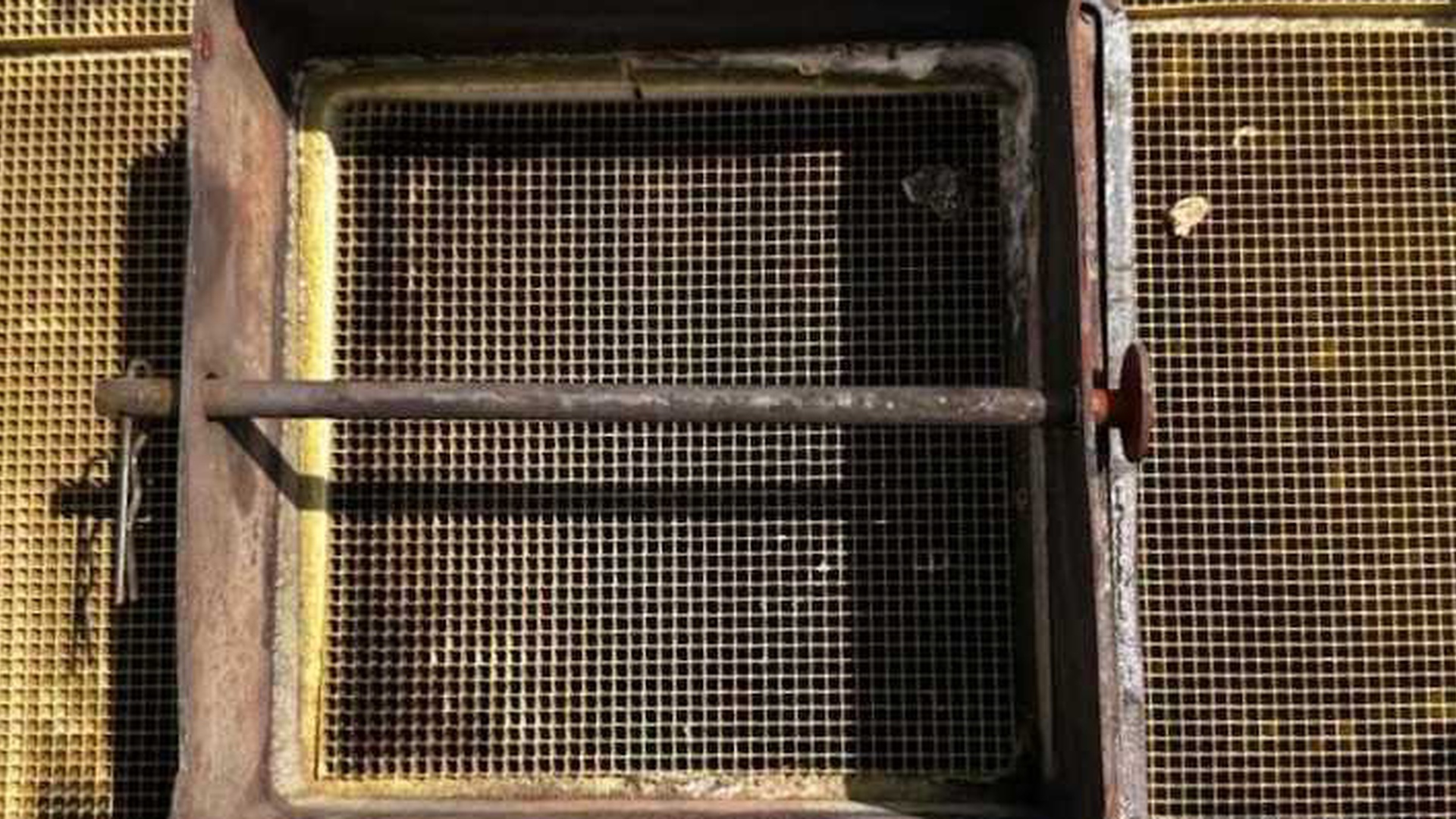
An industrial titanium–ruthenium (Ti/Ru) anode can reach the end of its operating life while still containing half its original precious metal. This apparent contradiction reflects a fundamental distinction: the amount of ruthenium remaining in an electrode is not the same as the amount still able to perform electrochemical work. An anode fails when its catalytic material loses electrical connection, electrolyte access, or sufficient activity, not necessarily when that material has been consumed. Understanding this distinction explains both the failure of dimensionally stable anodes (DSAs) and the substantial recovery value of exhausted screens. Much of their remaining precious metal is stranded rather than spent.
By replacing rapidly wearing graphite and other traditional anodes with durable coated titanium anodes, DSAs transformed industrial electrochemistry. In a typical Ti/Ru screen, the titanium carries a mixed metal oxide coating that includes ruthenium dioxide (RuO₂), the conductive catalyst, and titanium dioxide (TiO₂), which acts as a stabilizing agent. Other formulations use iridium or tantalum oxides. RuO₂ and TiO₂ share the same rutile crystal structure, which enables the coating to integrate closely. Nevertheless, practical coatings do not have to be perfectly uniform solid solutions; their composition and thermal treatment can create areas rich in ruthenium and areas rich in titanium, which have very different electrical properties. RuO₂ conducts electricity easily, whereas stoichiometric TiO₂ is a wide-bandgap semiconductor and can thus form a highly resistive barrier.
For electrolysis to occur, an active site must have two kinds of connections: an electronic pathway to the titanium current collector and an ionic pathway to the electrolyte. A large amount of ruthenium cannot compensate for the loss of either connection. This is why service life and metal consumption do not show a simple, proportional relationship. A relatively small amount of damage at a critical position can render a much larger volume of otherwise usable coating inoperative.
During operation, ruthenium gradually dissolves from surfaces in contact with the electrolyte, such as in accessible pores and cracks. When conditions are sufficiently oxidizing, Ru(IV) in RuO₂ can form higher-valent species, some of which may be soluble or volatile. The exact pathway depends on the potential, pH, electrolyte composition, and the reaction driving it.
Oxygen-evolving environments can be particularly demanding for RuO₂. In concentrated chloride electrolytes, favorable chlorine-evolution kinetics can reduce exposure to conditions that accelerate ruthenium degradation, although dissolution is not eliminated. As exposed regions lose ruthenium, they become relatively enriched in resistive titanium oxide. Eventually, conductive connections between Ru-rich domains can break. Percolation phenomena provide a framework for explaining this process: a composite needs a sufficiently connected conductive phase to carry current across it. Near the connectivity threshold, a modest additional loss can disproportionately increase resistance.
No single ruthenium percentage applies to all DSA systems. The threshold varies with coating composition, phase distribution, porosity, and geometry. The key issue is that conductivity depends on connectivity rather than the total amount of metal present. An aged coating may therefore contain a considerable amount of ruthenium in separate clusters or buried domains, yet still lack sufficient connected, accessible catalytic sites to maintain production. A bulk analysis will include that ruthenium, but the electrolysis cell cannot make use of it.
Another failure mode can occur beneath the catalytic layer. DSA coatings prepared by thermal treatment usually have a porous, 'mud-cracked' surface. Although this structure increases accessible surface area, the cracks and defects may also allow the electrolyte to reach the interface between the titanium and the coating. Titanium resists corrosion by forming a protective oxide film. When anodic operation continues for a long time, this oxide layer at the interface thickens, forming a progressively more resistive TiO₂ barrier between the metal substrate and the catalytic coating. For interfacial oxidation to occur, molecular oxygen does not need to diffuse down every crack; instead, electrolyte access and anodic polarization are sufficient to promote oxide growth. As this barrier builds up, a higher voltage is needed to maintain a constant production current. Ultimately, energy consumption becomes unacceptable, voltage limits are reached, or local deterioration makes continued operation impractical. The anode then becomes operationally inoperative even though a large part of its Ru-containing coating remains physically present. Unlike gradual catalyst consumption, interfacial passivation can disconnect a major portion of the coating without first removing it.
Surface preparation and coating uniformity affect the process; although a rougher surface enhances adhesion, thin layers on peaks, defects, and uneven coverage can become preferential degradation sites. The current then tends to concentrate in the remaining conductive areas, accelerating their deterioration while leaving the thicker areas unused. Thus, selective dissolution and substrate passivation allow a used screen to retain about 50% of the precious metal it originally had. Residual amounts higher than this, including cases reaching 70%, should be treated as case-specific rather than general.
Ruthenium can also become inaccessible if deposits, coating restructuring, or resistive phases block pore entrances. In such cases, the material may remain electrically connected but receive only a poor supply of electrolyte, or it may lose access in both respects. Several techniques can help distinguish between these situations. Cyclic voltammetry, together with Trasatti-type charge analysis, can separate the electrochemical response that is easily accessible from that which is accessible more slowly within porous coatings. Crucially, electrically disconnected ruthenium contributes no measurable charge; therefore, voltammetry cannot determine the total metal content. Electrochemical impedance spectroscopy can show an increase in both interfacial and charge-transfer resistance. Additional impedance features may indicate substrate passivation, although they are not uniquely diagnostic.
X-ray photoelectron spectroscopy examines the outermost surface and can detect ruthenium depletion or titanium enrichment. Cross-sectional microscopy and compositional mapping illustrate how the deterioration changes throughout the coating. A representative bulk chemical analysis determines the amount of remaining precious metal. Together, these techniques identify three amounts: the metal physically present, the metal electrochemically accessible, and the metal effectively supporting industrial operation.
Residual ruthenium makes exhausted screens valuable feedstock for specialist recovery and refurbishment. Refractory mixed oxides can resist conventional acid treatment, so recovery may require oxidative alkaline treatment, molten-salt processing, or other qualified stripping methods, followed by separation and refining. Some ruthenium-refining routes exploit volatile RuO₄, but its toxicity and strong oxidizing character require tightly contained industrial equipment. Substrate reuse also depends on inspection: stripping must not leave titanium unsuitable for recoating. Recovery yields and financial benefits vary with coating chemistry, residual loading, substrate condition, and processing costs. The central lesson is straightforward: a Ti/Ru screen reaches the end of its service life when its functional architecture fails, not when its precious metal inventory reaches zero. Broken conductive networks, an insulating titanium-oxide interface, and inaccessible pores can render substantial ruthenium reserves unusable in the cell yet still recoverable in the refinery.