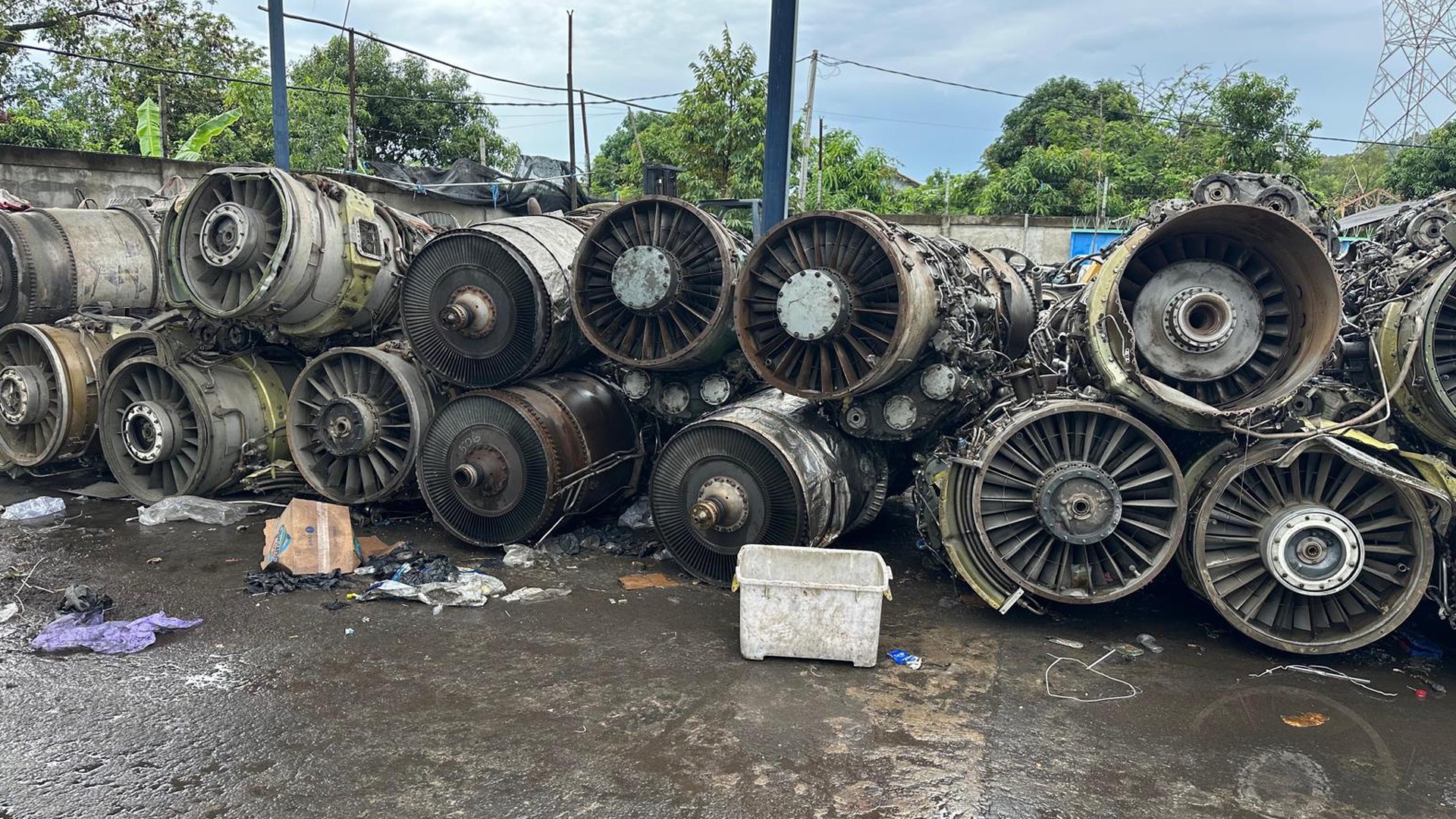
In the aerospace engineering and defense procurement landscape of 2026, the race for higher engine efficiency has become inseparable from the race for advanced materials. Modern gas turbine engines are being pushed to operate hotter, longer, and under greater mechanical stress than ever before. This is not just an incremental design trend; it reflects a major shift in propulsion thermodynamics, metallurgy, supply-chain strategy, and aftermarket economics.
At the center of this shift is ruthenium, a scarce platinum group metal that has become essential to the most advanced single-crystal turbine superalloys. Once known mainly to metallurgists and precious-metal refiners, ruthenium is now a strategic material for aerospace manufacturers, defense contractors, MRO facilities, fleet dismantlers, and specialized machine shops. Its presence in fourth- and fifth-generation turbine blades has transformed end-of-life hot-section components and machining scrap from ordinary nickel-alloy waste into high-value precious-metal assets.
The challenge is that much of this value is invisible to conventional recycling channels. General metal recyclers often lack the technology to identify, isolate, and monetize ruthenium. As a result, aerospace companies may lose substantial value when advanced superalloy scrap is treated as generic nickel or cobalt material. Specialized refiners such as Phoenix Refining are increasingly important because they have the hydrometallurgical and analytical capabilities needed to recover ruthenium, rhenium, platinum, palladium, and other strategic metals from these complex alloys.
Nickel-based single-crystal superalloys were developed to overcome one of the major weaknesses of earlier turbine materials: grain boundaries. In conventional polycrystalline metals, grain boundaries are natural sites for creep, cracking, and diffusion-assisted failure. By casting turbine blades as single crystals, manufacturers eliminate these weak points and greatly improve high-temperature creep resistance.
The strength of these alloys comes from a carefully engineered two-phase microstructure. The first phase is the gamma matrix, a nickel-rich solid solution strengthened by elements such as cobalt, chromium, molybdenum, and tungsten. Embedded within it is the gamma-prime phase, an ordered intermetallic compound based on Ni₃(Al, Ti, Ta). Gamma-prime precipitates typically occupy 65% to 70% of the alloy volume in advanced turbine materials and are especially valuable because their strength increases with temperature up to roughly 800°C to 850°C.
Together, the gamma matrix and gamma-prime precipitates block dislocation motion, making deformation under extreme heat and stress far more difficult. This microstructure is the foundation of modern turbine blade performance.
The development of single-crystal superalloys is often described in generations, defined largely by the addition of refractory elements such as rhenium and ruthenium.
First-generation single-crystal alloys, such as René 80 and SRR99, contained no rhenium. They relied mainly on traditional strengthening elements such as tungsten and molybdenum. Second-generation alloys introduced about 3% rhenium by weight, with examples including CMSX-4, PWA1484, and René N5. Rhenium dramatically improved creep resistance and raised temperature capability by roughly 30°C.
Third-generation alloys increased the rhenium content, often to 5% or 6% by weight. CMSX-10 and René N6 are representative examples. At first, this approach seemed like the logical path forward: more rhenium meant better high-temperature strength. But the approach eventually reached a metallurgical limit.
Rhenium is a powerful solid-solution strengthener because it has a high melting point, low diffusion rate, and strong tendency to cluster in the gamma matrix. However, excessive rhenium can destabilize the alloy during prolonged high-temperature service. This phenomenon became known as the rhenium paradox: the same element that improves short-term creep strength can contribute to long-term microstructural instability.
The main issue with high-rhenium third-generation superalloys is the formation of topologically close-packed (TCP) phases. These include sigma, mu, P, and R phases. They are brittle intermetallic compounds rich in refractory elements such as rhenium, tungsten, molybdenum, and chromium.
During long-term exposure above roughly 1,000°C, the gamma matrix can become supersaturated with refractory elements, triggering TCP precipitation. Once formed, TCP phases damage the alloy in several ways. They remove valuable strengthening elements from the gamma matrix, create brittle internal stress concentrators, and disrupt the coherent gamma/gamma-prime microstructure that resists deformation.
By the end of the third generation, aerospace metallurgy had reached a practical ceiling. Adding more rhenium improved initial strength but increased the risk of long-term instability. A new stabilizing element was needed.
Ruthenium provided the breakthrough. A platinum group metal with a melting point of approximately 2,334°C, ruthenium became the defining addition in fourth- and fifth-generation single-crystal superalloys. Typical ruthenium contents range from about 2% to 6% by weight.
Fourth-generation alloys such as MC-NG and TMS-138 use ruthenium to suppress TCP phase formation while maintaining high refractory content. Fifth-generation alloys such as TMS-162 and TMS-196 push ruthenium levels even higher.
The “ruthenium effect” refers to ruthenium’s ability to stabilize the alloy microstructure under extreme thermal exposure. One important mechanism is reverse partitioning. In conventional superalloys, rhenium, tungsten, and molybdenum strongly partition into the gamma matrix, increasing the risk of TCP formation. Ruthenium alters this behavior, encouraging some refractory elements to partition more favorably and reducing supersaturation in the gamma matrix.
Ruthenium also modifies lattice misfit between the gamma and gamma-prime phases, influencing rafting behavior, interfacial dislocation networks, and creep resistance. In addition, it slows the nucleation and growth of TCP phases, delaying the formation of damaging phases from hundreds of hours to potentially thousands of hours.
The mechanical benefit is significant. At 1,100°C and 137 MPa, advanced ruthenium-bearing alloys can greatly outperform earlier generations. TMS-138 has demonstrated creep rupture lives around 412 hours under such conditions, while fifth-generation alloys such as TMS-162 have exceeded 700 hours in comparable regimes. In short, ruthenium allows turbine blade alloys to retain the benefits of high rhenium and refractory loading without rapidly succumbing to TCP-driven degradation.
The same metal that enables next-generation turbine blades also creates a major procurement risk. Ruthenium is extraordinarily scarce. It is not mined as a primary metal; it is recovered entirely as a byproduct of platinum group metal production, which is often tied to nickel and copper extraction. This makes supply highly inelastic. If demand for aerospace rises sharply, producers cannot simply open a ruthenium mine.
Annual global primary ruthenium production is only about 30 metric tons. Approximately 90% to 92% of that supply comes from South Africa, especially the Bushveld Igneous Complex. Much of the remainder comes from Russia’s Norilsk-Talnakh deposits, with smaller contributions from Zimbabwe. This concentration creates serious geopolitical and logistical vulnerability. South African power instability, labor disputes, mine disruptions, Russian sanctions, and export restrictions can all affect global supply.
Demand is also growing beyond aerospace. Ruthenium is used in high-capacity hard disk drives, semiconductor interconnects, and barrier layers, and as a catalyst for green hydrogen technologies such as proton exchange membrane electrolyzers. These competing uses have contributed to structural deficits and price volatility. In 2026, ruthenium has traded in an elevated range, rising from roughly $18.50 per gram to more than $50 per gram in some market conditions. This volatility reinforces its classification as a critical strategic material for the United States, European Union, and allied defense industrial bases.
The use of ruthenium in advanced superalloys changes the economics of aerospace scrap. End-of-life turbine blades, nozzle guide vanes, blisks, off-spec castings, gating systems, runners, sprues, swarf, and turnings are no longer just high-nickel or high-cobalt materials. Often, they are concentrated sources of ruthenium and rhenium.
For example, a scrapped turbine blade weighing 500 grams and made from a fifth-generation alloy containing 6% ruthenium and 5.8% rhenium would contain about 30 grams of ruthenium and 29 grams of rhenium. At a ruthenium value of $50 per gram, the ruthenium alone represents about $1,500 of intrinsic metal value. That can exceed the value of the nickel, cobalt, chromium, and other base metals combined.
For commercial MRO facilities, military fleet dismantlers, and aerospace machine shops, this value can scale quickly. Overhaul programs may generate large quantities of retired hot-section components. Precision machining of airfoils and fir-tree roots produces swarf and turnings with the same valuable alloy chemistry as the finished part. Although swarf is often discounted as fine, reactive, and contaminated with oils or coolants, ruthenium-bearing swarf can be a high-grade precious-metal feedstock when processed correctly.
Conventional scrap channels are not designed for ruthenium recovery. General metal recyclers typically rely on bulk sorting, melting, and base-metal valuation. Processes such as electric arc furnace melting, induction melting, plasma arc melting, or generic alloy remelting may recover nickel and cobalt value but often destroy the recoverable value of trace PGMs.
During conventional melting, ruthenium and other PGMs may be diluted into large heats, partitioned into slag, lost through uncontrolled pathways, or rendered economically unrecoverable. Even if the atoms remain physically present, their strategic value is lost because they are no longer isolated, traceable, or economically recoverable.
General recyclers also often lack the analytical tools needed to assay ruthenium and rhenium in complex superalloy matrices. Without accurate ICP-MS, XRF, or comparable high-precision analysis, the material may be priced as generic nickel alloy rather than as precious-metal-bearing aerospace superalloy. The result is financial leakage: aerospace companies may receive payment for nickel, cobalt, or chromium, yet receive little or nothing for ruthenium and rhenium.
Recovering ruthenium from aerospace superalloys is complex. These alloys are engineered to resist heat, oxidation, corrosion, and mechanical degradation, so breaking them down requires specialized chemical and metallurgical infrastructure.
A specialized refinery may begin with mechanical size reduction, thermal removal of oils or coolants, and pyrometallurgical pretreatment to facilitate dissolution of the alloy. The material is then processed in aggressive acidic and oxidizing environments that convert base metals and precious metals into soluble complexes. Solvent extraction, ion exchange, filtration, and other advanced techniques can then separate rhenium, platinum group metals, nickel, cobalt, and other constituents.
Ruthenium presents a unique opportunity because it can form volatile ruthenium tetroxide, RuO₄, under strongly oxidizing conditions. In specialized closed systems with proper safety and environmental controls, ruthenium can be oxidized, volatilized, separated, trapped, reduced back into stable form, precipitated, and converted into high-purity ruthenium sponge. This is sophisticated hydrometallurgy, not ordinary scrap processing.
The aerospace industry’s pursuit of hotter, more efficient engines has pushed metallurgy into a new era. Fourth- and fifth-generation single-crystal superalloys owe much of their performance to ruthenium’s ability to suppress TCP phase degradation, stabilize high-rhenium microstructures, and extend creep and fatigue life at extreme temperatures.
But this breakthrough has created a parallel challenge. Ruthenium is rare, geographically concentrated, supply-inelastic, and increasingly in demand across multiple high-tech industries. As prices rise and supply risks intensify, the secondary market for aerospace superalloy scrap becomes strategically important.
MRO facilities, defense contractors, fleet dismantlers, and precision machine shops should no longer view end-of-life turbine blades, swarf, turnings, and foundry revert as ordinary alloy scrap. These materials may contain significant quantities of ruthenium and rhenium, and routing them through conventional recycling channels can result in a loss of their value. Specialized refining is essential for identifying, recovering, and monetizing these critical metals.