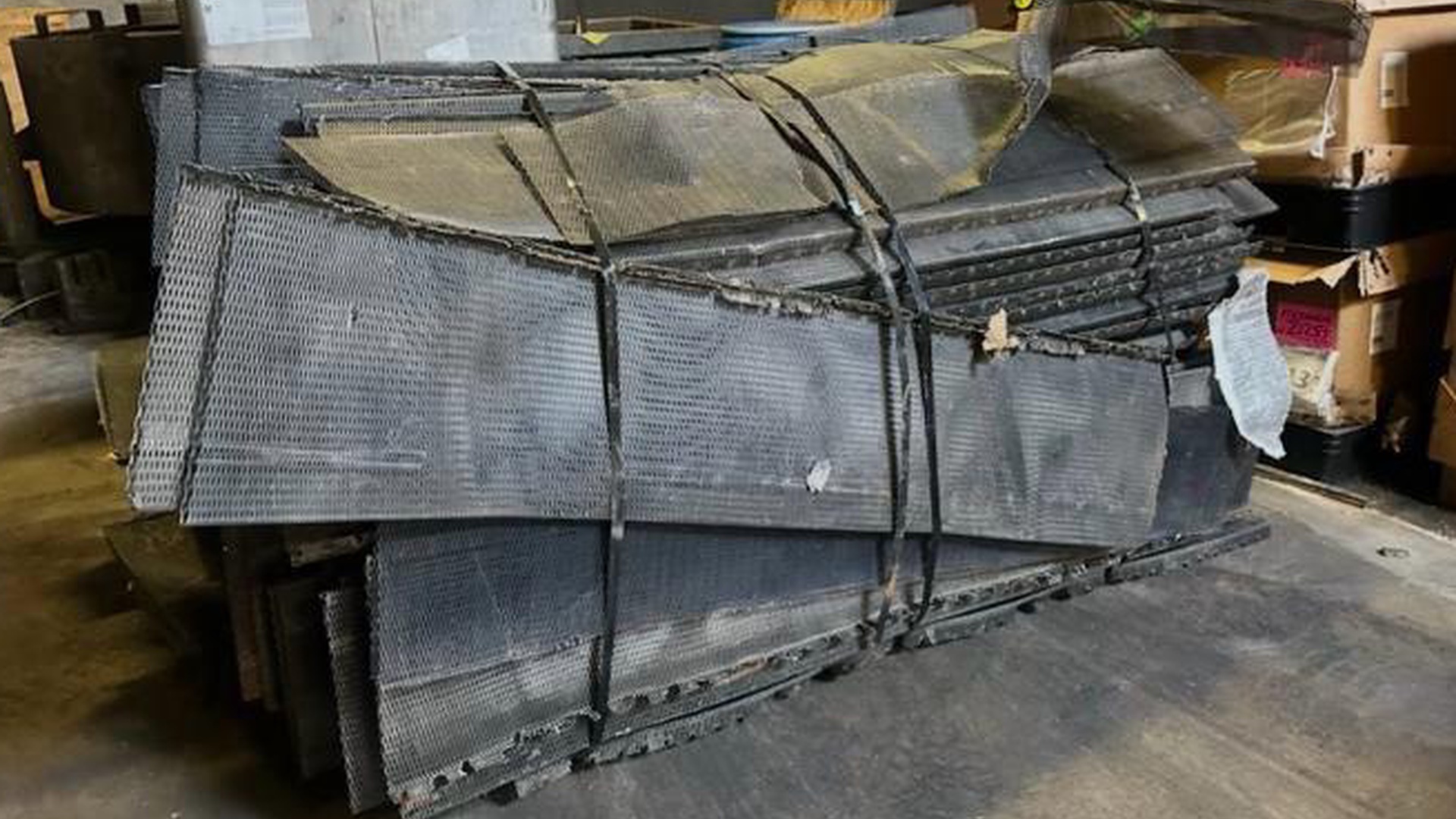
A handheld XRF reading can identify surface chemistry, but it cannot determine the recoverable value of a spent anode lot on its own. A retired mixed metal oxide (MMO) anode may no longer operate efficiently, yet still contain commercially significant quantities of ruthenium and iridium. For quality assurance managers, metallurgical analysts, and scrap procurement agents, that distinction is critical: electrochemical failure does not mean precious-metal exhaustion.
Nevertheless, spent titanium mesh is sometimes priced from a few handheld X-ray fluorescence (XRF) readings. A weak ruthenium or iridium signal becomes the basis for a low-grade classification or an offer approaching bare titanium scrap value. That shortcut confuses a local surface measurement with a representative inventory of platinum-group metals (PGMs). Surface deposits, coating heterogeneity, instrument calibration, and expanded-mesh geometry can all suppress or distort the result. Defensible valuation requires representative sampling and a validated laboratory assay, not simply more confidence in the scanner.
MMO anodes consist of a titanium substrate carrying a thin catalytic coating, commonly containing ruthenium dioxide or iridium dioxide stabilized with oxides such as titanium dioxide or tantalum pentoxide. Their cracked, porous coating provides substantial electrochemically active surface area. During service, several degradation mechanisms can occur: catalytic material dissolves, coating fragments detach, deposits accumulate, and electrically resistive titanium dioxide grows at the substrate–coating interface. Interfacial passivation can interrupt electrical contact while leaving portions of the catalytic coating physically present. Consequently, an anode may reach its retirement voltage before its PGMs are exhausted.
Residual loading is also uneven. Current distribution, electrolyte flow, operating history, and coating condition create different wear patterns across a panel and between panels. Neither visual appearance nor operational failure establishes how much metal remains.
XRF works by directing primary X-rays onto a sample. These photons excite atoms, which emit characteristic fluorescent X-rays. The instrument identifies elements from the emitted energies and estimates their concentrations from measured intensities using calibration models.
Importantly, XRF has no universal penetration depth. Effective information depth depends on photon energy, the selected emission line, matrix composition, density, and measurement geometry. Some signals are strongly surface-sensitive, originating mainly within a few micrometers; others can provide information from appreciably deeper regions.
The commercial problem, therefore, is not that every handheld beam stops at a fixed depth. It is that a reading from a layered, fouled coating cannot automatically be converted into total ruthenium or iridium content.
Spent mesh may carry calcium- and magnesium-containing scale, organic fouling, or deposited process-metal oxides. These materials lie between the analyzer and the remaining catalyst. The primary beam must pass through the deposits to excite the PGMs, and the resulting fluorescence must pass back through them to reach the detector. Depending on deposit composition, thickness, and fluorescence energy, this can substantially weaken the measured signal. Lower-energy lines are generally more vulnerable to absorption.
The role of passivation needs careful distinction. A titanium dioxide layer beneath an intact catalytic coating does not automatically shield that coating from an analyzer above it. Its principal significance is electrical: it helps explain why valuable catalysts can remain after anode failure. Exposed titanium oxide, redistributed material, and overlying deposits can nevertheless complicate the measured matrix. Standard bulk-alloy calibrations poorly match this structure. A thin, discontinuous PGM-bearing oxide coating over titanium is not a homogeneous alloy. Specialized XRF coating methods can address defined layered systems, but they require suitable standards, geometry control, and validation.
Expanded titanium mesh introduces further uncertainty into handheld XRF measurements. Part of the primary beam can pass through open apertures and strike backing material rather than the anode itself. Meanwhile, angled strands change the beam's incidence and the fluorescence exit angles, altering both the illuminated area and the distance photons travel through coatings and deposits. Strand edges and overlapping features can obstruct the detector's view of coated surfaces, while small changes in instrument placement alter the proportions of coating, exposed titanium, and open space being measured.
Fluorescence is emitted in multiple directions, so angled strands do not simply redirect it like a mirror. Instead, the analytical uncertainty arises from uncontrolled variations in excitation, absorption, detector visibility, and background scatter. These effects can suppress PGM signals, but measurement errors are not exclusively downward. Scanning an unusually well-preserved area can also overstate the lot's value. A handful of spot readings cannot reliably resolve either risk.
Handheld XRF remains useful for screening, identifying unexpected contaminants, and mapping relative differences, but final settlement requires a more rigorous measurement chain. The process begins with defining the lot and collecting representative samples across panels, locations, and relevant service histories. Sampling principles associated with Pierre Gy emphasize controlling heterogeneity and selection bias. Depending on the material and sampling plan, you may need destructive sectioning, size reduction, or validated coating-recovery procedures, although grinding the entire lot is not automatically required.
Account for every material stream generated during preparation. Cleaning, cutting, and handling can release PGM-bearing fines, making it essential to retain or separately account for deposits, washings, detached coating, and residues. Without these controls, preparation itself can introduce losses and cause the assay to underestimate the lot's precious-metal content.
The laboratory must then verify that its preparation method adequately decomposes the refractory coating and makes the target metals available for measurement. High-fired ruthenium and iridium oxides can resist routine acid digestion, so validated fusion, specialized digestion, or an appropriate collection method may be required before ICP-OES or ICP-MS analysis. No preparation method should be assumed to achieve complete recovery without supporting evidence.
Quality controls should include preparation duplicates, blanks, suitable reference materials where available, residue checks, and recovery studies. Ruthenium requires particular attention because strongly oxidizing conditions can produce volatile species and create an additional pathway for analytical loss. Together, these safeguards provide a defensible basis for settlement that isolated surface readings cannot supply.
A settlement contract should specify sampling, moisture basis, analytical methods, quality controls, retained samples, and independent umpire procedures. An ISO/IEC 17025-accredited laboratory should have demonstrated competence for the relevant matrix and method. Finally, contained PGM is not the same as recoverable or payable PGM. Laboratory content, refinery recovery, treatment charges, and commercial deductions are separate quantities that should remain transparent. The practical conclusion is straightforward: a weak surface signal is not proof of an exhausted coating. Treat handheld XRF as a screening tool, not a purchase valuation, and base settlement on representative preparation, validated analysis, and an auditable metal balance.