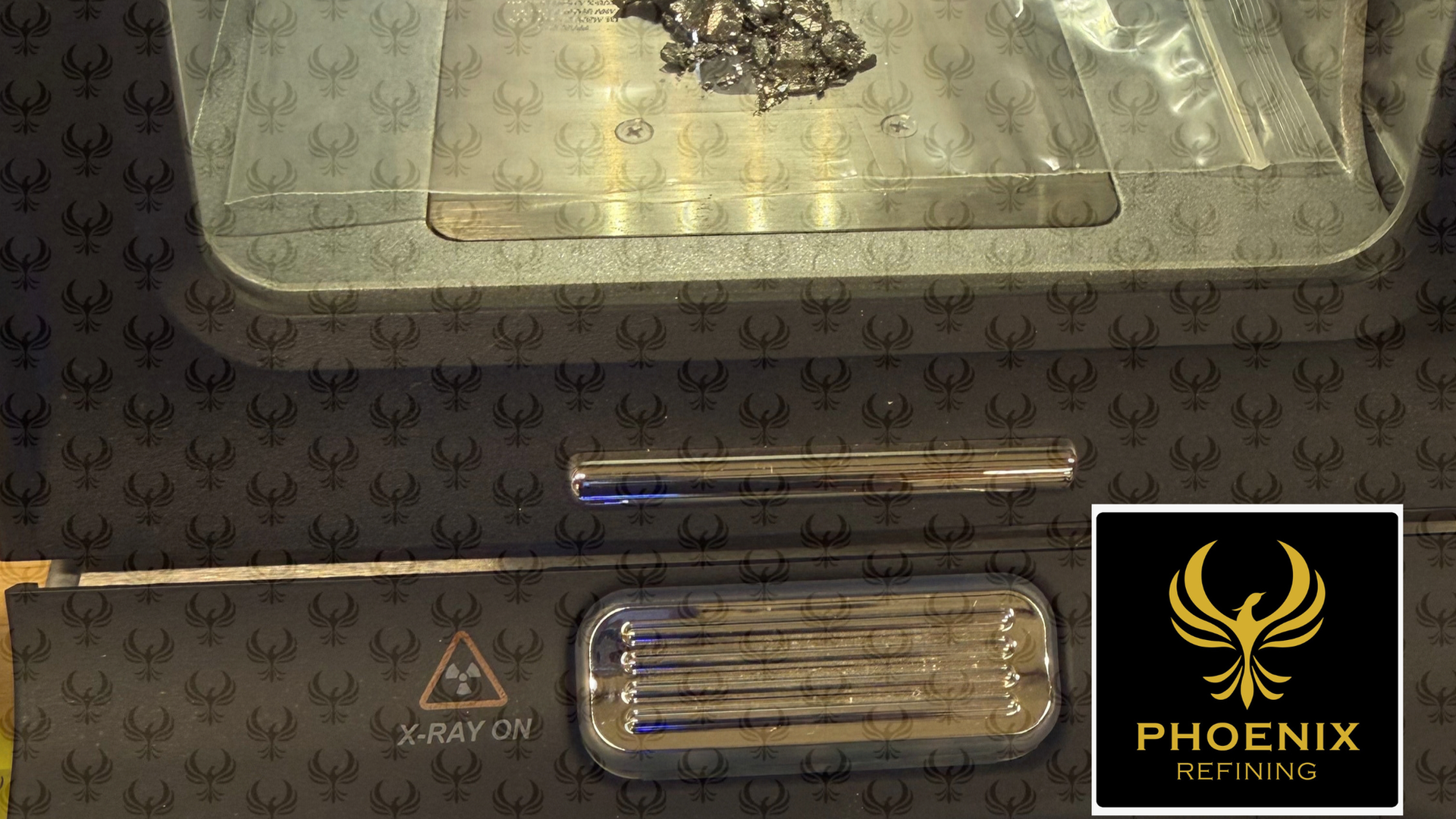
Iridium is one of the rarest and most valuable metals in Earth's crust; its unusual resistance to heat, corrosion, and chemical attack makes it essential for specialized technologies such as high-temperature crucibles and proton-exchange-membrane electrolyzers used in hydrogen production. The same properties that give iridium strategic importance also make it very difficult to locate, process, and refine. As a result, mineral exploration has regularly produced reports of supposed "high-grade iridium veins" or the discovery of new standalone iridium mines. These claims almost always conflict with the geological and economic conditions that govern platinum-group-metal production; they often stem from an analytical illusion, particularly misinterpreting field-portable X-ray fluorescence (pXRF) readings from arsenic-rich sulfide minerals. The result is what is known as a "phantom iridium mine": an apparent discovery that reflects not an exceptional orebody but spectral overlap, incorrect instrument settings, and a misunderstanding of how iridium occurs in nature.
No commercial mines are exclusively devoted to iridium. Instead, it comes as a small byproduct of large-scale mining operations that extract platinum, palladium, nickel, copper, and other platinum-group metals (PGMs). The world's principal PGM regions, such as South Africa's Bushveld Complex, Zimbabwe's Great Dyke, Russia's Norilsk-Talnakh area, Canada's Sudbury Basin, and the Stillwater Complex in the United States, produce iridium only because they process vast amounts of sulfide ore to extract more abundant metals. This clearly indicates iridium's extreme rarity: it occurs in the Earth's crust at only a few parts per trillion, and global annual mine output is usually only a few tonnes, not hundreds or thousands of tonnes. South Africa is the main supplier, especially via the UG2 and Merensky Reef systems of the Bushveld Complex. Even there, iridium makes up only a minimal part of the total recoverable metal content.
Economic considerations are just as important. Mining operations are established because platinum, palladium, nickel, copper, rhodium, and gold together can cover the huge expenses associated with shafts, mills, concentrators, smelters, and refineries. Iridium serves as a minor supplement. Higher iridium prices alone cannot easily drive new production, as the metal is such a small part of the ore stream that it cannot finance a new mine or refinery. This means iridium supply is structurally inelastic. When demand for catalysts used in electrolyzers or other advanced industrial applications rises suddenly, production cannot simply increase. Extra iridium is generally produced only if the original mining operations for platinum, palladium, nickel, or copper also expand.
Iridium is mainly linked to mafic and ultramafic magmatic systems, large bodies of iron- and magnesium-rich magma that become saturated with sulfur as they cool. At sulfur saturation, an immiscible sulfide liquid separates from the silicate magma; because platinum-group metals strongly prefer the sulfide phase, they are drawn from vast volumes of magma and concentrated into relatively small amounts of dense sulfide droplets.
As these droplets settle and accumulate, they form ore zones containing large amounts of pyrrhotite, pentlandite, chalcopyrite, chromite, and other minerals. These deposits are economically valuable for nickel, copper, platinum, and palladium. At the same time, iridium occurs in trace quantities, either dissolved in sulfide minerals, concentrated in microscopic inclusions, or present in rare platinum-group minerals.
Arsenic has a significant role in this field of mineralogy. When sulfur and arsenic conditions are right, platinum group minerals (PGMs) may occur as arsenides and sulfarsenides, such as sperrylite, irarsite, platarsite, and hollingworthite. Sperrylite, which is platinum arsenide (PtAs₂), is a well-known PGM mineral in places like Sudbury. Irarsite, generally given as (Ir, Ru, Rh, Pt)AsS, is especially important since it can host iridium directly. This association makes arsenic a useful geological tracer in PGM exploration. However, this fact does not mean that every arsenic-rich rock contains economically significant iridium. For instance, arsenopyrite (FeAsS) is common in many hydrothermal and sulfide systems and may contain large amounts of arsenic without any iridium.
Even when iridium is present, it is not easy to recover. The ore is crushed, ground, and then concentrated by froth flotation, producing a sulfide concentrate containing nickel, copper, iron, sulfur, and the platinum-group metals. The concentrate is then smelted at temperatures above 1,500°C, separating a sulfide matte from a silicate slag. During further conversion and refining, operators remove iron and sulfur, while arsenic-containing components may volatilize and must be captured in gas-cleaning systems. In many operations, arsenic ultimately ends up in the flue dust as arsenic trioxide, a toxic substance that must be handled and disposed of under strict control.
Hydrometallurgical refining then removes nickel and copper. Because PGMs are chemically noble, they do not dissolve in ordinary acid leaching and remain in a concentrated precious-metal residue. Platinum, palladium, and gold can be dissolved and separated first. Still, iridium is particularly refractory and can withstand aqua regia and other strong lixiviants, so it often requires oxidative fusion, usually in the presence of sodium peroxide, before it can be put into solution. Only after several separation stages can iridium be precipitated, purified, and reduced to metallic sponge. This entire process shows that a raw rock sample cannot realistically be considered 'iridium ore' just because a handheld instrument gives an iridium reading.
The main cause of false iridium claims is portable X-ray fluorescence analysis. This technique directs X-rays at a sample and measures the secondary X-rays atoms in the sample emit. Although each element has its own set of emission energies, some lines are extremely close.
The key interference is between arsenic and iridium: arsenic's main K-alpha emission line is at about 10.54 keV, and iridium's L-beta line is near 10.71 keV. The two lines differ by only about 170 electron volts. Older handheld instruments usually employ silicon PIN detectors, which have energy resolutions of about 180 to 230 eV in the field. Because the separation between the arsenic and iridium peaks is less than the detector's resolving power, the instrument may observe a single, broad, distorted peak instead of two separate signals. As a result, the instrument may misattribute a strong arsenopyrite arsenic response to iridium, entirely or in part.
The problem worsens when lead is present. Lead's L-alpha line is about 10.55 keV, almost identical to arsenic's line at 10.54 keV. In polymetallic samples containing both lead and arsenic, the spectral area can become so crowded that you can no longer interpret it reliably without advanced deconvolution techniques and proper calibration. Software settings also matter; 'Precious metals' or 'alloy' modes are intended for refined metals, jewelry, or scrap, not for complex geological materials. If the chosen method omits arsenic, lead, sulfur, or other relevant elements from its analytical library, the instrument's algorithm might assign an uncertain peak to the nearest allowed category, such as iridium. The screen might then show a high percentage of iridium even if the sample is merely an arsenic-rich sulfide.
A persistent myth among prospectors is that arsenic and iridium are mistaken for one another because they have the same density; they do not. Iridium has a density of about 22.56 g/cm³, while arsenic has a density of around 5.73 g/cm³. The two densities are therefore very different. More significant still, density has no bearing on X-ray emission energies. Spectral interference is caused by transitions of electrons within the electron shells of atoms, not by the bulk physical density. The myth may have developed from the well-known fact that gold and tungsten have similar densities, but it has no connection to XRF interference between arsenic and iridium.
A handheld XRF reading can help with preliminary screening, but it does not prove an iridium deposit. Because arsenic-rich sulfides can cause spectral interference near iridium's characteristic X-ray lines, you must confirm any apparent iridium readings in the field with independent laboratory analysis before drawing any geological or economic conclusions.
If you believe your scrap contains iridium, Phoenix Refining can help you verify its presence through ICP analysis. Laboratory-based inductively coupled plasma testing can assess samples with much higher sensitivity and specificity than field XRF, helping differentiate real platinum-group-metal content from false positives caused by arsenic and other analytical interferences. Before treating a pXRF result as an iridium find, submit a properly collected and prepared representative sample for confirmation.