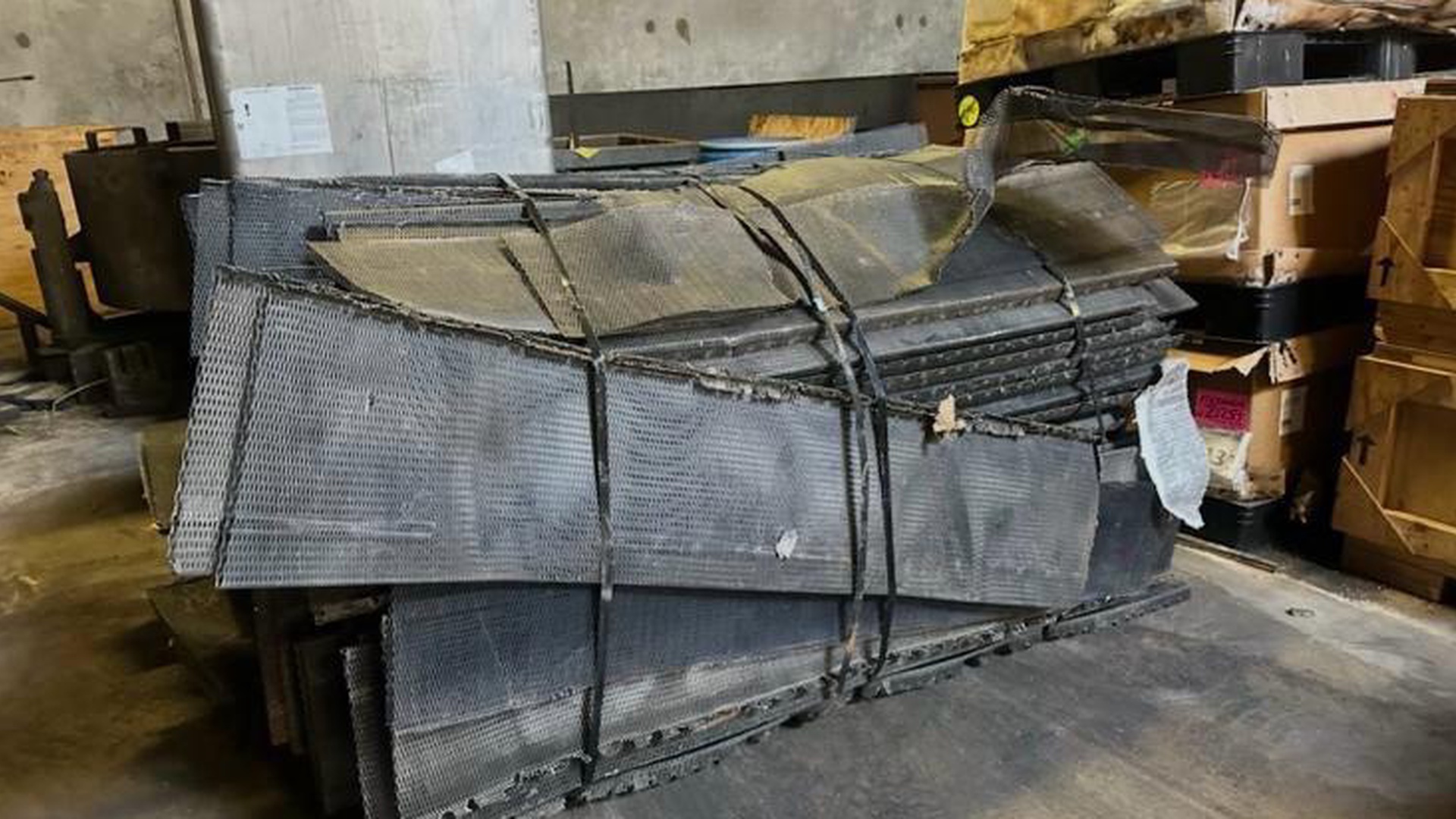
Increasingly, municipal and industrial water treatment plants use electrochemical methods to disinfect water, control biofouling, and treat contaminants that don't respond to conventional processes. If a plant uses on-site hypochlorite generation for disinfection or electro-oxidation for tough industrial wastewater, performance often depends on an easy-to-overlook component: the coated titanium mesh anode. Don't treat the mesh as ordinary metal waste when it reaches the end of its electrochemical life; retired anodes may still contain valuable amounts of ruthenium, iridium, platinum, and a reusable titanium substrate. With proper recovery and recoating procedures, they can become a source of maintenance savings rather than a disposal expense.
Electrochlorination is one of the most well-established applications of electrochemistry in water treatment. It involves passing direct current through a brine solution made from sodium chloride. At the anode, chloride ions oxidize to chlorine, which then reacts with water to form hypochlorous acid and hypochlorite, the disinfecting agents. At the cathode, water is reduced, producing hydrogen gas and hydroxide ions. As a result, water treatment plants can produce sodium hypochlorite on site, reducing the need to transport and store bulk chlorine gas or commercial bleach. For water-treatment operators, the benefits are practical: reduced chemical-handling risk, a continuous disinfectant supply, and the ability to vary disinfectant levels to meet plant requirements. Municipal water systems, cooling water treatment, seawater intakes, ballast water treatment, and industrial process water operations widely use the method.
Electro-oxidation serves a different, yet increasingly important, function. It treats wastewater containing persistent or complex organic substances, such as those with high chemical oxygen demand (COD), dyes, pharmaceuticals, landfill leachate components, and some emerging contaminants. Unlike chlorine production for disinfection, electro-oxidation uses anodic reactions to generate highly reactive oxidizing species, such as surface-bound hydroxyl radicals and, depending on the water chemistry, mediated oxidants. These species can decompose difficult contaminants that might otherwise pass through biological treatment. Outcomes depend heavily on electrode material, water composition, chloride concentration, pH, conductivity, and reactor design. More advanced electrode materials, such as certain titanium sub-oxides and mixed-metal-oxide systems, improve current efficiency, oxidation capacity, and durability in specific applications. In both technologies, the anode is not merely a metal conductor; it is a deliberately engineered reaction surface that determines energy consumption, output, selectivity, and service life.
In many electrochlorination and electro-oxidation cells, the anode is a dimensionally stable anode (DSA) made of expanded titanium mesh. In various arrangements, the anode starts as expanded titanium mesh, typically made from commercially pure titanium such as ASTM B265 Grade 1 or Grade 2. In a narrow-gap electrolyzer, this mesh sits directly opposite the cathode. Current flows from the power supply through the electrode and into the electrolyte, driving the required reaction at the coated anode surface. The close spacing reduces electrical resistance, while the mesh structure provides an efficient combination of structural strength, available surface area, and fluid flow.
Unlike a solid plate, expanded mesh allows brine or wastewater to pass through the electrode structure. The open spaces promote mass transfer and decrease the local pressure drop. They also help gases escape. In electrochlorination, chlorine may form at the anode while hydrogen forms at the cathode; in oxygen-evolving applications, effective gas management matters just as much. If bubbles build up on electrode surfaces, they can cause gas blinding, uneven current distribution, hot spots, and reduced efficiency.
Titanium provides the mechanical framework, but the coating provides the catalytic performance. Most anodes use a mixed metal oxide, or MMO, layer applied to the titanium surface. Ruthenium dioxide is commonly used in coatings intended for chlorine evolution because it reduces the overpotential required for that reaction. Iridium dioxide is frequently included where oxygen evolution, acidic service, or higher durability requirements are involved. Other oxides, such as tantalum oxide, can improve stability and coating structure. The titanium substrate itself forms a natural titanium dioxide film, giving it exceptional corrosion resistance. However, that same oxide can become a problem when it thickens beneath a degrading coating.
The anode is seldom retired after a sudden, obvious break; instead, its performance tends to deteriorate slowly as electrochemical dissolution, chemical attack, turbulence, abrasion, scale removal, and normal operating stresses wear away the MMO coating. A major failure mode is interfacial passivation. When the catalytic coating thins or is damaged, the underlying titanium dioxide layer may thicken. Although titanium dioxide provides protection, it is also electrically resistive. Once it isolates the titanium substrate from the remaining catalyst, the current can no longer reach the active coating efficiently. The precious-metal catalyst may still be physically there, but it becomes electrochemically inaccessible.
That is why visual inspection by itself is not sufficient. The coating might be only a few micrometers thick, and an anode that appears to be in satisfactory condition could be approaching electrical exhaustion. The most valuable warning sign is a continuous rise in cell voltage at constant current density. As resistance increases and catalytic activity decreases, the rectifier must apply a higher voltage to maintain output. Plants should monitor voltage according to cell, current, temperature, brine quality, and production rate—not just respond to one abnormal reading.
Specific energy consumption is also a key indicator; healthy on-site hypochlorite systems generally operate within 4.5 to 5.5 kWh per kilogram of available chlorine, though specific targets vary with design and operating conditions. A substantial, ongoing rise may indicate decreased Faradaic efficiency, scaling, poor brine quality, insufficient flow, or coating deterioration. Operators should also note more frequent acid cleaning, unstable output, uneven current distribution, increased gas accumulation, or higher calcium and magnesium scale. If scale is the main problem, acid washing can restore performance, but repeated cleaning or overly aggressive cleaning can accelerate MMO loss. Cleaning practices must follow the limits set by the equipment manufacturer and should be reviewed whenever cleaning frequency increases.
When retiring an anode, it may be tempting to wire brush, sand, or grind the surface to reveal new metal, but that method generally offers no benefit. Because mechanical abrasion can't remove only the depleted MMO coating while keeping the titanium base intact, it can thin the mesh strands, weaken the intersections, change dimensional tolerances, and destroy the anchor profile needed for successful recoating.
Putting used mesh into a normal scrap stream can be just as wasteful. An electrically spent anode may still contain much of its original precious-metal content. Even when passivation renders the electrode useless in service, ruthenium, iridium, and other platinum-group metals still have value. The better solution is to follow a specialist toll-refining and recoating program. In this process, controlled chemical stripping removes the remaining coating instead of destructive mechanical cleaning. The recovered coating material is usually analyzed using techniques such as X-ray fluorescence and ICP-OES to determine the amount of recoverable precious metals. Under the terms of the contract, that value can be applied against the costs of refining, recoating, or replacement. The titanium mesh itself can then be examined, re-profiled, etched, and recoated with a new MMO formulation. Since the original titanium substrate, fabrication, welding, and mesh forming are kept, recoated anodes can cost much less than new assemblies. Recoating can often reduce capital expenditure by about 55% to 62% compared with a full replacement, provided the substrate is still mechanically sound.
Operators should take away this: titanium mesh anodes are engineered process assets, not disposable items. Operators should closely monitor trends in voltage and energy consumption, investigate recurring scaling and cleaning issues, and withdraw the electrodes before performance losses lead to operational failures.
If replacement is necessary, preserve the mesh, keep its service record, and send it to a qualified refining and recoating partner. Recovering the precious metals and reusing the titanium substrate help reduce overall lifecycle cost, minimize material waste, and support more resilient electrochemical water-treatment operations.